Dans un réseau ethernet relié par un concentrateur (ou hub), chaque machines reçoit tous les paquets qui circulent sur le réseau. En fonctionnement normal, les cartes réseau ne réceptionnent que les paquets qui leur sont destinés, mais on peut faire en sorte qu’elles transmettent tous les paquets au système et les inspecter avec tcpdump.
Les hubs sont de moins en moins utilisés. Ils sont généralement remplacés par des commutateurs (ou switch) qui savent déterminer (en fonction de l’adresses MAC) sur quel câble il faut envoyer un paquet. Les machines ne reçoivent donc généralement que les paquets qui leur sont destinés.
L’utilitaire tcpdump permet d’inspecter les paquets qui sont reçus et transmis par une carte réseau.
Filtrage
Il est possible de sélectionner les paquets à « écouter » en fonction d’expressions. Ainsi, ne seront affichées / traitées que les informations pour lesquelles le résultat de l’expression est vérifié. Une expression est composée de primitives et d’opérateurs logiques.
Une primitive est un identifiant précédé de mots clés qui indiquent le type de l’identifiant. Par exemple la primitive src port 21 contient les éléments suivants :
le mot clé src qui indique que l’identifiant ne porte que sur la source du paquet
le mot clé port qui indique que l’identifiant est le port du paquet
You need to use the sudo command which is use to execute a command as another user. It allows a permitted user to execute a command as the superuser or another user, as specified in the /etc/sudoers (config file that defines or list of who can run what) file. The sudo command allows users to do tasks on a Linux system as another user.
sudo command
sudo is more more secure than su command. By default it logs sudo usage, command and arguments in /var/log/secure (Red Hat/Fedora / CentOS Linux) or /var/log/auth.log (Ubuntu / Debian Linux).
If the invoking user is root or if the target user is the same as the invoking user, no password is required. Otherwise, sudo requires that users authenticate themselves with a password by default. Once a user has been authenticated, a timestamp is updated and the user may then use sudo without a password for a short period of time (15 minutes unless overridden in sudoers).
/etc/sudoers Syntax
Following is general syntax used by /etc/sudoers file:
USER HOSTNAME=COMMAND
Where,
USER: Name of normal user
HOSTNAME: Where command is allowed to run. It is the hostname of the system where this rule applies. sudo is designed so you can use one sudoers file on all of your systems. This space allows you to set per-host rules.
COMMAND: A simple filename allows the user to run the command with any arguments he/she wishes. However, you may also specify command line arguments (including wildcards). Alternately, you can specify « » to indicate that the command may only be run without command line arguments.
I have a backup sync program on local server. I have an ssh password less login set up, and I can run commands on an external server in bash script doing:
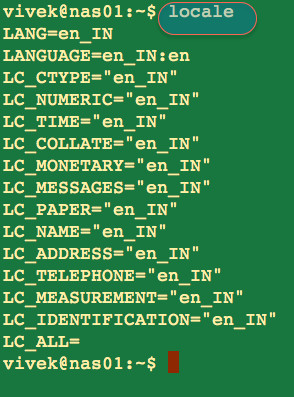
What is a « locale » on a Linux operating system? How do I set or get locals (i18n) values on a Linux operating system?
Locales defines language and country specific setting for your programs and shell session. You can use locales to see date, time, number, currency and other values formatted as per your country or language on a Linux or Unix-like system.
To set system’s locale you need use shell variable. For example, LANG variable can be used to set en_US (English US) language.
How do I show current locale settings on a Linux or Unix?