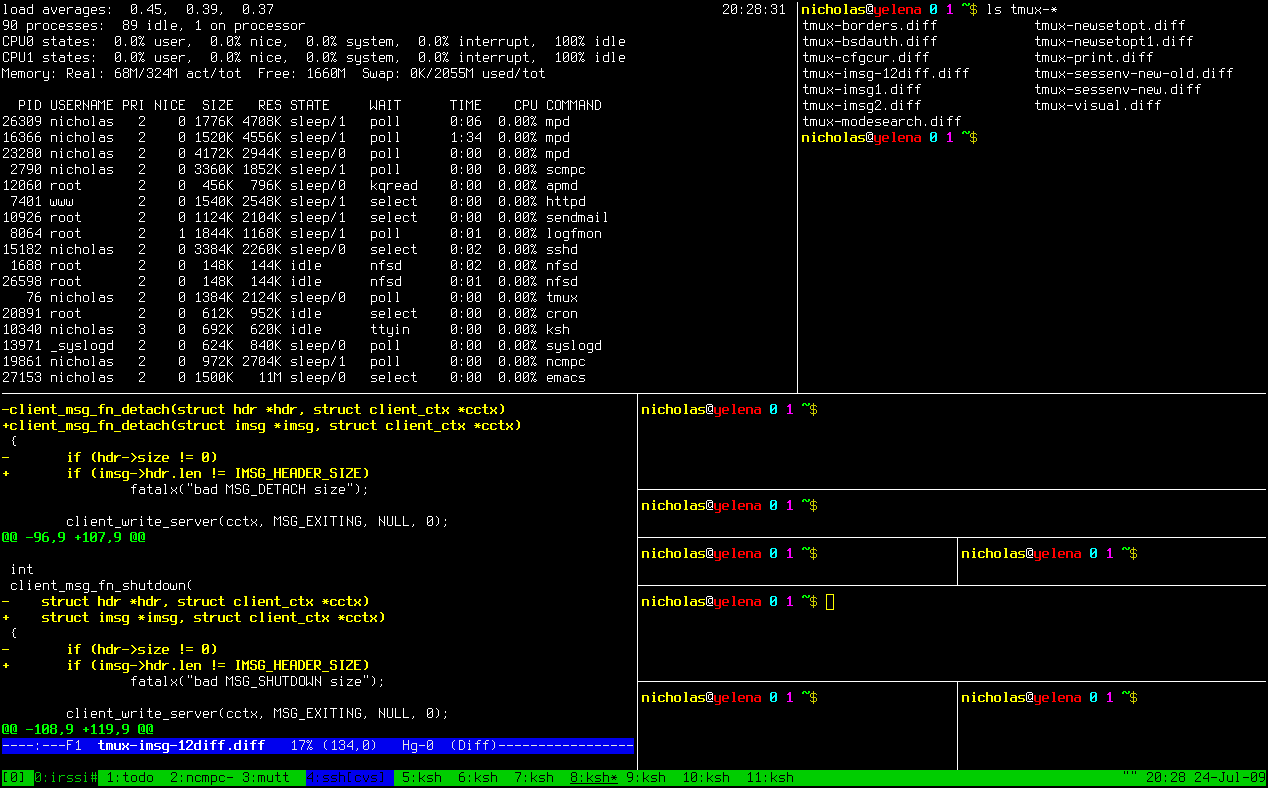
A comparison of the features (or more-so just a table of notes for accessing some of those features) for GNU screen and BSD-licensed tmux.
The formatting here is simple enough to understand (I would hope). ^ means ctrl+, so ^x is ctrl+x. M- means meta (generally left-alt or escape)+, so M-x is left-alt+x
It should be noted that this is no where near a full feature-set of either group. This – being a cheat-sheet – is just to point out the most very basic features to get you on the road.
Trust the developers and manpage writers more than me. This document is originally from 2009 when tmux was still new – since then both of these programs have had many updates and features added (not all of which have been dutifully noted here).
Action
tmux
screen
start a new session
tmux OR tmux new OR tmux new-session
screen
re-attach a detached session
tmux attach OR tmux attach-session
screen -r
re-attach an attached session (detaching it from elsewhere)
tmux attach -d OR tmux attach-session -d
screen -dr
re-attach an attached session (keeping it attached elsewhere)
tmux attach OR tmux attach-session
screen -x
detach from currently attached session
^b d OR ^b :detach
^a ^d OR ^a :detach
rename-window to newname
^b , <newname> OR ^b :rename-window <newn>
^a A <newname>
list windows
^b w
^a w
list windows in chooseable menu
^a «
go to window #
^b #
^a #
go to last-active window
^b l
^a ^a
go to next window
^b n
^a n
go to previous window
^b p
^a p
see keybindings
^b ?
^a ?
list sessions
^b s OR tmux ls OR tmux list-sessions
screen -ls
toggle visual bell
^a ^g
create another window
^b c
^a c
exit current shell/window
^d
^d
split window/pane horizontally
^b «
^a S
split window/pane vertically
^b %
^a |
switch to other pane
^b o
^a <tab>
kill the current pane
^b x OR (logout/^D)
collapse the current pane/split (but leave processes running)
^a X
close other panes except the current one
^b !
cycle location of panes
^b ^o
swap current pane with previous
^b {
swap current pane with next
^b }
show time
^b t
show numeric values of panes
^b q
toggle zoom-state of current pane (maximize/return current pane
^b z
break the current pane out of its window (to form new window)
Tmux, à l’instar de Screen, est un multiplexeur de terminaux, outil permettant d’exploiter plusieurs terminaux au sein d’un seul et même affichage.
Installation
Tmux n’est pas installé par défaut. Pour l’installer à l’aide d’un utilitaire graphique il suffit d’Installer le paquetstmux. Par l’installer avec apt-get depuis un terminal, il suffit de saisir la commande suivante :
Many system administrators seem to have problems with the concepts of pipes and redirection in a shell. A coworker recently asked me how to deal with log files. How to find the information he was looking for. This article tries to shed some light on it.
Input / Output of shell commands
Many of the basic Linux/UNIX shell commands work in a similar way. Every command that you start from the shell gets three channels assigned:
STDIN (channel 0): Where your command draws the input from. If you don’t specify anything special this will be your keyboard input.
STDOUT (channel 1): Where your command’s output is sent to. If you don’t specify anything special the output is displayed in your shell.
STDERR (channel 2): If anything wrong happens the command will send error message here. By default the output is also displayed in your shell.
Try it yourself. The most basic command that just passes everything through from STDIN to STDOUT is the ‘cat’ command. Just open a shell and type ‘cat’ and press Enter. Nothing seems to happen. But actually ‘cat’ is waiting for input. Type something like “hello world”. Every time you press ‘Enter’ after a line ‘cat’ will output your input. So you will get an echo of everything you type. To let ‘cat’ know that you are done with the input send it an ‘end-of-file’ (EOF) signal by pressing Ctrl-D on an empty line.
The pipe(line)
A more interesting application of the STDIN/STDOUT is to chain commands together. The output of the first command becomes the input of the second command. Imagine the following chain:
The contents of the file /var/log/syslog are sent (as input) to the grep command. grep will filter the stream for lines containing the word ‘postfix’ and output that. Now the next grep picks up what was filtered and filter it further for the word ‘removed’. So now we have only lines containing both ‘postfix’ and ‘removed’. And finally these lines are sent to ‘wc -l’ which is a shell command counting the lines of some input. In my case it found 27 of such lines and printed that number to my shell. In shell syntax this reads:
The ‘|’ character is called pipe. A sequence of such commands joined together with pipes are called pipeline.
Useless use of ‘cat’
Actually ‘cat’ is supposed to be used for concatenating files. Like “cat file1 file2”. But some administrators abuse the command to put something into a pipeline. That’s bad style and the reason why Randal L. Schwartz (a seasoned programmer) used to hand out virtual “Useless use of cat” awards. Shell commands usually can take a filename as the last argument as an input. So this would be right:
grep something /var/log/syslog | wc -l
While this works but is considered bad style:
cat /var/log/syslog | grep something | wc
Or if you knew that grep even has a “-c” option to count lines the whole task could be done with just grep:
lsof is the sysadmin/security über-tool. I use it most for getting network connection related information from a system, but that’s just the beginning for this powerful and too-little-known application. The tool is aptly called lsof because it “lists openfiles“. And remember, in UNIX just about everything (including a network socket) is a file.
Interestingly, lsof is also the Linux/Unix command with the most switches. It has so many it has to use both minuses and pluses.
As you can see, lsof has a truly staggering number of options. You can use it to get information about devices on your system, what a given user is touching at any given point, or even what files or network connectivity a process is using.