How to monitor OpenFlow messages with packet sniffer
As a key enabler for software-defined networking (SDN), OpenFlow was initially introduced in the academia as a way to enable innovation on production networks which had traditionally been built with closed and proprietary networking hardware. OpenFlow offloads the high-level routing/forwarding decisions (control plane) from networking devices such as switches, and moves the control plane on to a separate controller. The networking devices then simply forward traffic, as programmed by the external OpenFlow controller. It is the OpenFlow protocol that is used by the OpenFlow controller to program the networking devices.
Suppose you have an OpenFlow testbed running, which consists of an OpenFlow controller and a set of OpenFlow-capable switches. For troubleshooting purposes, you want to capture and examine OpenFlow messages exchanged between the controller and the switches. For this you could monitor exchanged OpenFlow messages either at the controller or the switch side, but what if it is not convenient to do so? Another way is to « sniff » network packets on the OpenFlow control channel and interpret the packets.
In this tutorial, I am going to show how to sniff live OpenFlow control packets and decode OpenFlow messages contained in the packets.
Note that for such packet sniffing to work, SSL must be disabled in any existing OpenFlow control channels between the controller and switches. Let’s assume we are not talking about any production environment here, so the SSL is off for now.
Method One: Sniff OpenFlow Messages via Wireshark GUI
If you want to monitor OpenFlow messages using packet sniffing, the most user-friendly way is via Wireshark, a GUI-based packet sniffer. A nice thing about Wireshark is its extensive list of built-in and custom dissectors. Each dissector decodes some part of packet data based on a specific network protocol. For pretty much any existing network protocol, there is a corresponding Wireshark dissector (either built-in or contributed by a third-party). The OpenFlow protocol is not an exception.
While there is an official OpenFlow dissector, I am going to use a third-party OpenFlow dissector developed by Big Switch Networks, since the former seems to have patchy/incomplete support for different OpenFlow versions.
Here is how to install the OpenFlow dissector for Wireshark.
$ mkdir -p ~/.wireshark/plugins
$ cd ~/.wireshark/plugins
$ wget http://www.projectfloodlight.org/openflow.lua
Now go ahead and start Wireshark.
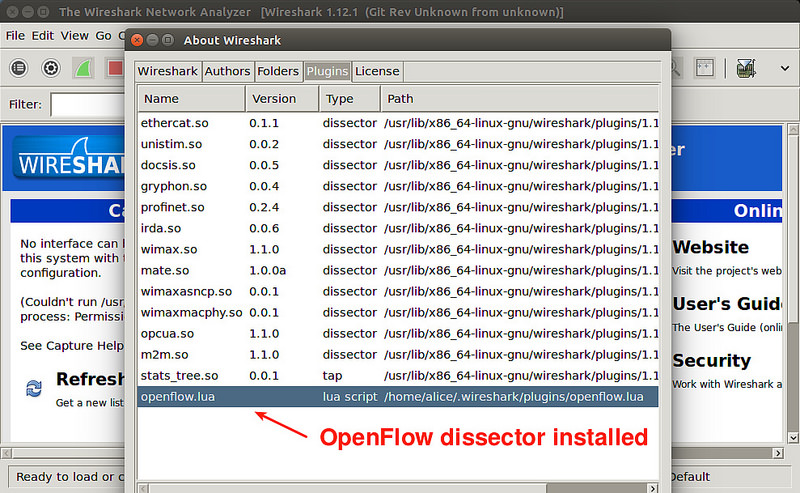
To verify that the OpenFlow dissector is successfully installed, go to « Help » -> »About Wireshark ».
Under the « Plugin » tab, if you see openflow.lua listed, it means the Openflow dissector is successfully loaded on Wireshark.
 Comme un débutant tâchant d’effectuer une réparation automobile, je peux me battre pendant des heures en essayant d’utiliser convenablement mes rudimentaires outils (marteau, clefs, etc.) pour la tâche à laquelle je me suis attablé. Une fois que j’ai lamentablement échoué et que j’ai fait remorquer ma guimbarde par un vrai mécanicien, à chaque fois il farfouille dans sa grosse caisse à outils pour y trouver le parfait bidule qui, d’un coup de cuillère à pot, répare le truc. L’art du scan de port, c’est la même chose. Les experts connaissent des douzaines de techniques de scan et choisissent la bonne (ou une combinaison) pour une tâche donnée. D’un autre côté, les utilisateurs inexpérimentés et les script kiddies essaient de tout résoudre avec le scan SYN par défaut. Comme Nmap est gratuit, la seule barrière à franchir pour atteindre la maîtrise du scan est la connaissance. C’est bien mieux que l’automobile, où il faut une grande expérience pour déterminer que vous avez besoin d’une plieuse à tablier hydraulique, mais où quand bien même il faut encore payer des centaines d’euros pour en disposer.
 Serving data to users outside of an internal network, public Web servers are typically the first point of contact for an external attack. In addition, internal networking ports are the most revealing and most often attacked ports on a server. That’s why you need to make sure you’ve disabled the services that are specifically for intranets.