Archive

Archives pour 09/2026

How to live stream video from webcam on Linux

24/09/2026 Aucun commentaire

Source: Xmodulo

Have you ever wanted to live stream a video feed from your webcam for someone else? You could use any existing video chat software such as Skype, Google+ Hangouts. However, if you do not want to rely on any third-party streaming infrastructure, you can set up your own webcam streaming server in house.

In this tutorial, I will describe how to live stream video from webcam by using VLC. VLC is an open-source, cross platform media player which can handle virtually all video and audio formats. VLC can also run as a streaming server supporting various streaming protocol such as RTP, HTTP, RTSP, etc.

Before attempting to set up webcam streaming on your own, you need to understand the huge potential security risk of streaming a webcam over the Internet. Anyone can tap into your streaming feed unless you properly access control the streaming server, and encrypt the streaming traffic. I’ll briefly mention several security protections against threats towards the end of the tutorial.

Install VLC on Linux

Before setting up a streaming server with VLC, install VLC first.

To install VLC on Debian, Ubuntu or Linux Mint:

$ sudo apt-get install vlc

To install VLC on Fedora, first enable RPM Fusion’s free repository, and then run:

$ sudo yum install vlc

To install VLC on CentOS or RHEL 6, first set up EPEL repository, and then use the following commands:

$ cd /etc/yum.repos.d/
$ sudo wget http://pkgrepo.linuxtech.net/el6/release/linuxtech.repo
$ sudo yum install vlc

Verify Webcam Device on VLC

Next, verify whether a webcam device is successfully detected on your Linux system and VLC.

To do so, first find out the device name of your webcam with the following command. In this example, the device name of the webcam is /dev/video0.

$ ls /dev/video*
/dev/video0

Now use the following command to test video from your webcam. Replace « video0 » with your own device name.

$ vlc v4l2:///dev/video0

If your webcam is successfully detected by VLC, you should see a video stream of yourself.

Configure Webcam Streaming on VLC

Assuming that your webcam is successfully recognized by VLC, I am going to show how to configure webcam streaming. In this setup, webcam is streamed over HTTP in WMV format.

To configure VLC for webcam streaming, first launch VLC.

$ vlc

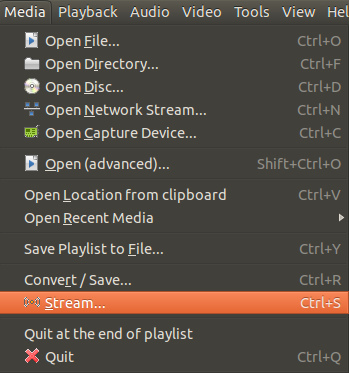
Choose « Streaming » from VLC menu.

9652347212_67126e2037

On the screen, choose webcam/audio device name (e.g., /dev/video0 for webcam, and hw:0,0 for audio). Click on the checkbox of « Show more options ». Make a note of value strings in « MRL » and « Edit Options » fields. We will use these strings later in the tutorial. Click on « Stream » button at the bottom.

Lire la suite…

Categories: Logiciel Tags:

What are useful CLI tools for Linux system admins ?

22/09/2026 Aucun commentaire

System administrators (sysadmins) are responsible for day-to-day operations of production systems and services. One of the critical roles of sysadmins is to ensure that operational services are available round the clock. For that, they have to carefully plan backup policies, disaster management strategies, scheduled maintenance, security audits, etc. Like every other discipline, sysadmins have their tools of trade. Utilizing proper tools in the right case at the right time can help maintain the health of operating systems with minimal service interruptions and maximum uptime.

14853747084_e14cf18e8f_z

This article will present some of the most popular and useful CLI tools recommended for sysadmins in their day to day activities. If you would like to recommend any useful tool which is not listed here, don’t forget to share it in the comment section.

Network Tools

1. ping: Check end-to-end connectivity (RTT delay, jitter, packet loss) of a remote host with ICMP echo/reply. Useful to check system status and reachability.

2. hping: Network scanning and testing tool that can generate ICMP/TCP/UDP ping packets. Often used for advanced port scanning, firewall testing, manual path MTU discovery and fragmentation testing.

3. traceroute: Discover a layer-3 forwarding path from a local host to a remote destination host with TTL-limited ICMP/UDP/TCP probe packets. Useful to troubleshoot network reachability and routing problems.

4. mtr: A variation of traceroute which characterizes per-hop packet loss/jitter with running statistics. Useful to characterize routing path delays.

5. netcat/socat: A swiss army knife of TCP/IP networking, allowing to read/write byte streams over TCP/UDP. Useful to troubleshoot firewall policies and service availability.

6. dig: DNS troubleshooting tool that can generate forward queries, reverse queries, find authoritative name servers, check CNAME, MX and other DNS records. Can be instructed to query a specific DNS server of your choosing.

7. nslookup: Another DNS checking/troubleshooting tool. Works with all DNS queries and records. Can query a particular DNS server.

8. dnsyo: A DNS testing tool which checks DNS propagation by performing DNS lookup from over a number of open resolvers located across 1,500 different networks around the world.

9. lsof: Show information about files (e.g., regular files, pipes or sockets) which are opened by processes. Useful to monitor processes or users in terms of their open network connections or opened files.

10. iftop: A ncurses-based TUI utility that can be used to monitor in real time bandwidth utilization and network connections for individual network interfaces. Useful to keep track of bandwidth hogging applications, users, destinations and ports.

11. netstat: A network statistics utility that can show status information and statistics about open network connections (TCP/UDP ports, IP addresses), routing tables, TX/RX traffic and protocols. Useful for network related diagnosis and performance tuning.

12. tcpdump: A popular packet sniffer tool based on libpcap packet capture library. Can define packet capturing filters in Berkeley Packet Filters format.

13. tshark: Another CLI packet sniffer software with full compatibility with its GUI counterpart, Wireshark. Supports 1,000 protocols and the list is growing. Useful to troubleshoot, analyze and store information on live packets.

14. ip: A versatile CLI networking tool which is part of iproute2 package. Used to check and modifying routing tables, network device state, and IP tunneling settings. Useful to view routing tables, add/remove static routes, configure network interfaces, and otherwise troubleshoot routing issues.

15. ifup/ifdown: Used to bring up or shut down a particular network interface. Often a preferred alternative to restarting the entire network service.

16. autossh: A program which creates an SSH session and automatically restarts the session should it disconnect. Often useful to create a persistent reverse SSH tunnel across restrictive corporate networks.

17. iperf: A network testing tool which measures maximum bi-directional throughput between a pair of hosts by injecting customizable TCP/UDP data streams in between.

18. elinks/lynx: text-based web browsers for CLI-based server environment.

Lire la suite…