Archive

Articles taggués ‘securite’

How to Protect Yourself from NSA Attacks on 1024-bit DH

03/05/2024 Comments off

nsa attacksWhen NSA gets you worrying

In a post on Wednesday, researchers Alex Halderman and Nadia Heninger presented compelling research suggesting that the NSA has developed the capability to decrypt a large number of HTTPS, SSH, and VPN connections using an attack on common implementations of the Diffie-Hellman key exchange algorithm with 1024-bit primes. Earlier in the year, they were part of a research group that published a study of the Logjam attack, which leveraged overlooked and outdated code to enforce « export-grade » (downgraded, 512-bit) parameters for Diffie-Hellman. By performing a cost analysis of the algorithm with stronger 1024-bit parameters and comparing that with what we know of the NSA « black budget » (and reading between the lines of several leaked documents about NSA interception capabilities) they concluded that it’s likely NSA has been breaking 1024-bit Diffie-Hellman for some time now.

The good news is, in the time since this research was originally published, the major browser vendors (IE, Chrome, and Firefox) have removed support for 512-bit Diffie-Hellman, addressing the biggest vulnerability. However, 1024-bit Diffie-Hellman remains supported for the forseeable future despite its vulnerability to NSA surveillance. In this post, we present some practical tips to protect yourself from the surveillance machine, whether you’re using a web browser, an SSH client, or VPN software.

Disclaimer: This is not a complete guide, and not all software is covered.

Web Browser

To make sure you’re using the strongest crypto, you have to look at the encryption algorithms (or cipher suites) that your browser supports. There’s an excellent tool, How’s My SSL?, that will test your browser’s cipher suite support. The relevant area of the page is the bottom, Given Cipher Suites. You want to make sure that you don’t see the text « _DHE_ » in the list of ciphersuites – although the Elliptic Curve variant of Diffie-Hellman, represented by suites with « _ECDHE_ » is okay. It is important to note that there is a trade-off here: removing your clients support for « _DHE_ » ciphers will eliminate the risk of this attack, but it may also remove Forward Secrecy support altogether for some sites. Here’s how to remove those « _DHE_ » cipher suites if you still have them:

Firefox

(tested with 40.0.3)

Open a new tab, enter « about:config » into the location bar and hit the « Enter » key. If you get a warning page, click « I’ll be careful, I promise! » This will bring you to the Firefox configuration settings. In the search bar up top, type « .dhe_ » and hit the « Enter » key. This should result in two settings being displayed: « security.ssl3.dhe_rsa_aes_128_sha » and « security.ssl3.dhe_rsa_aes_256_sha ». Double-click both of them to change the value from « true » to « false ».
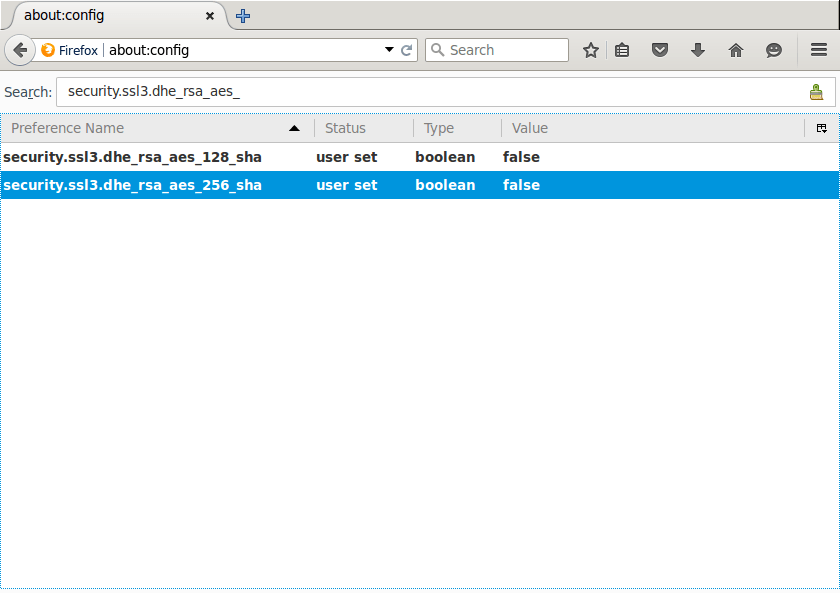
ff

Now, if you refresh the How’s My SSL page, the « _DHE_ » ciphersuites should be gone!

Lire la suite…

How to log in to MySQL server without password

03/05/2024 Comments off

mysql without passwordIn order to log in to a MySQL server, you can run mysql command along with your login credentials and server’s IP address as arguments. For example:

$ mysql -u $MYSQL_ROOT -p $MYSQL_PASS -h 192.168.10.1

However, besides the inconvenience of typing extra arguments, using plain-text login credentials in a command line like above is really not a secure way to access a MySQL server. In a multi-user Linux environment, what you type in command line can easily be revealed to others who happen to run ps on the same host at the same time.

MySQL offers a way for you to log in to MySQL server without password, by using an external MySQL configuration file. In Linux, there are two different kinds of MySQL configuration files: (1) /etc/my.cnf and (2) ~/.my.conf. While any system-wide MySQL configuration is defined in /etc/my.cnf, any user-specific MySQL configuration is stored in ~/.my.cnf. You can leverage ~/.my.cnf, to define your MySQL login credential in the file.

$ vi ~/.my.cnf
[client]
user=alice
password=alice_passwd
host=192.168.10.1

Make sure to have the configuration file readable to you only.

$ chmod 0600 ~/.my.cnf

Once ~/.my.cnf is created, simply typing mysql command will let you log in to 192.168.10.1 as alice, and you no longer need to provide login password separately.

Source: Xmodulo

MySQL Cluster Replication: Multi-Master and Circular Replication

01/05/2024 Comments off

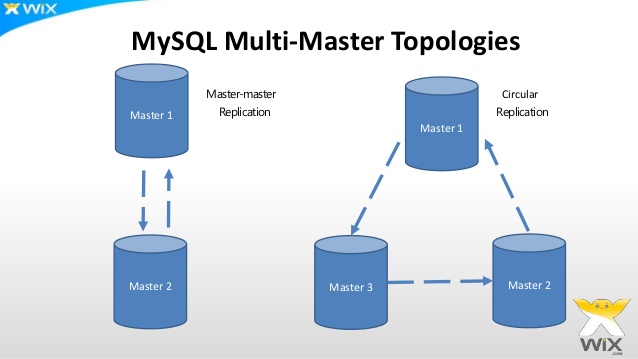
mysql-multi-master-replication-14-638Beginning with MySQL 5.1.18, it is possible to use MySQL Cluster in multi-master replication, including circular replication between a number of MySQL Clusters.

Prior to MySQL 5.1.18, multi-master replication including circular replication was not supported with MySQL Cluster replication. This was because log events created in a particular MySQL Cluster were wrongly tagged with the server ID of the master rather than the server ID of the originating server.

Circular replication example. In the next few paragraphs we consider the example of a replication setup involving three MySQL Clusters numbered 1, 2, and 3, in which Cluster 1 acts as the replication master for Cluster 2, Cluster 2 acts as the master for Cluster 3, and Cluster 3 acts as the master for Cluster 1. Each cluster has two SQL nodes, with SQL nodes A and B belonging to Cluster 1, SQL nodes C and D belonging to Cluster 2, and SQL nodes E and F belonging to Cluster 3.

Circular replication using these clusters is supported as long as the following conditions are met:

  • The SQL nodes on all masters and slaves are the same
  • All SQL nodes acting as replication masters and slaves are started using the --log-slave-updates option

Lire la suite…

Denial-of-service Attack – DoS using hping3 with spoofed IP in Kali Linux

30/04/2024 Comments off

Source: blackmoreops.com

In computing, a denial-of-service (DoS) or distributed denial-of-service (DDoS) attack is an attempt to make a machine or network resource unavailable to its intended users. Although the means to carry out, the motives for, and targets of a DoS attack vary, it generally consists of efforts to temporarily or indefinitely interrupt or suspend services of a host connected to the Internet. In this article I will show how to carry out a Denial-of-service Attack or DoS using hping3 with spoofed IP in Kali Linux.Denial-of-service-Attack-–-DoS-using-hping3-with-spoofed-IP-in-Kali-Linux-blackMORE-Ops-51

As clarification, distributed denial-of-service attacks are sent by two or more persons, or bots, and denial-of-service attacks are sent by one person or system. As of 2014, the frequency of recognized DDoS attacks had reached an average rate of 28 per hour.

Perpetrators of DoS attacks typically target sites or services hosted on high-profile web servers such as banks, credit card payment gateways, and even root nameservers.

Denial-of-service threats are also common in business, and are sometimes responsible for website attacks.

This technique has now seen extensive use in certain games, used by server owners, or disgruntled competitors on games, such as popular Minecraft servers. Increasingly, DoS attacks have also been used as a form of resistance. Richard Stallman has stated that DoS is a form of ‘Internet Street Protests’. The term is generally used relating to computer networks, but is not limited to this field; for example, it is also used in reference to CPU resource management.

One common method of attack involves saturating the target machine with external communications requests, so much so that it cannot respond to legitimate traffic, or responds so slowly as to be rendered essentially unavailable. Such attacks usually lead to a server overload. In general terms, DoS attacks are implemented by either forcing the targeted computer(s) to reset, or consuming its resources so that it can no longer provide its intended service or obstructing the communication media between the intended users and the victim so that they can no longer communicate adequately.

Denial-of-service attacks are considered violations of the Internet Architecture Board’s Internet proper use policy, and also violate the acceptable use policies of virtually all Internet service providers. They also commonly constitute violations of the laws of individual nations.

hping3 works well if you have other DoS tools such as GoldenEye running (using multiple tools that attacks same site/server/service increases the chances of success). There are agencies and corporations to runs DoS attack map in Realtime. that shows worldwide DDoS attacks almost in realtime.

Lire la suite…

Allow A Normal User To Run Commands As root Under Linux / UNIX Operating Systems

27/04/2024 Comments off

Source: nixCRAFT

You need to use the sudo command which is use to execute a command as another user. It allows a permitted user to execute a command as the superuser or another user, as specified in the /etc/sudoers (config file that defines or list of who can run what) file. The sudo command allows users to do tasks on a Linux system as another user.

sudo command

sudo is more more secure than su command. By default it logs sudo usage, command and arguments in /var/log/secure (Red Hat/Fedora / CentOS Linux) or /var/log/auth.log (Ubuntu / Debian Linux).

If the invoking user is root or if the target user is the same as the invoking user, no password is required. Otherwise, sudo requires that users authenticate themselves with a password by default. Once a user has been authenticated, a timestamp is updated and the user may then use sudo without a password for a short period of time (15 minutes unless overridden in sudoers).

/etc/sudoers Syntax

Following is general syntax used by /etc/sudoers file:

USER HOSTNAME=COMMAND

Where,

  • USER: Name of normal user
  • HOSTNAME: Where command is allowed to run. It is the hostname of the system where this rule applies. sudo is designed so you can use one sudoers file on all of your systems. This space allows you to set per-host rules.
  • COMMAND: A simple filename allows the user to run the command with any arguments he/she wishes. However, you may also specify command line arguments (including wildcards). Alternately, you can specify «  » to indicate that the command may only be run without command line arguments.

Lire la suite…

Categories: Système Tags: , ,