Archive

Articles taggués ‘performance’

WordPress Performance Tuning

23/05/2024 Comments off

wordpress performance tuning
WordPress is one of the most popular content publishing platform used by some of the very high traffic website. Beauty of the wordpress is in its simplicity. If you will setup your WordPress correctly then your website performance will be fantastic. In this article we will explore various aspect of the WordPress Performance Tuning. Before going further let me clear that why you need to optimize your WordPress website performance.

Why you should spend time on WordPress Performance Tuning ?

Performance tuning or Optimization is required due to following reason:

  1. If you will correctly optimize or tune your WordPress performance then your visitor experience will be better.
  2. Search engines are giving high preference to high speed website.  So your SEO will be improved.
  3. Sometime while doing your WordPress performance tuning you will analyzed and remove unwanted thing from your WordPress which reduce your server work. So your server will have less load.

Tool / Plugin / Stuff you need while WordPress Performance tuning

WordPress performance tuning does not mean to only changing some configuration of your WordPress. There are several area where you need to fine tune like apache(your webserver), Mysql etc. So before going further you need following tool/plugin

  1. Installation of plugin w3 total plugin.
  2. Firefox web browser with firebug tool.
  3. Google Page Speed Test  or GT Metrix.
  4. SSH connection to your server (only required if you want to tune Apache and MySQL performance).
  5. A good Internet speed.

Before going further for your WordPress Performance Tuning please arrange above written tool.

Analyze your WordPress Performance

Before going to optimize your WordPress Performance you need to analyze that whether your website performance is good or bad. Or in other word we can say that you need to check whether your website is served quickly or not. Following are the factor which mainly affect your website performance and you need to check.

  1. Time taken to load your web page
  2. Number of CSS, js and Images are getting downloaded on every request
  3. CSS and JS are placed correctly or not.

You can check your website performance in either Google Page Speed or Gtmetrix. I prefer to use Gtmetrix. Both tool will gives rating to your website Speed and suggestion to improve your website performance further. Gtmetrix will also provide you the timeline waterfall(what is repose time of your website and how many images, css , js or other resources are getting downloaded) of your website. I prefer Gtmetrix because of TimeLine waterfall feature.
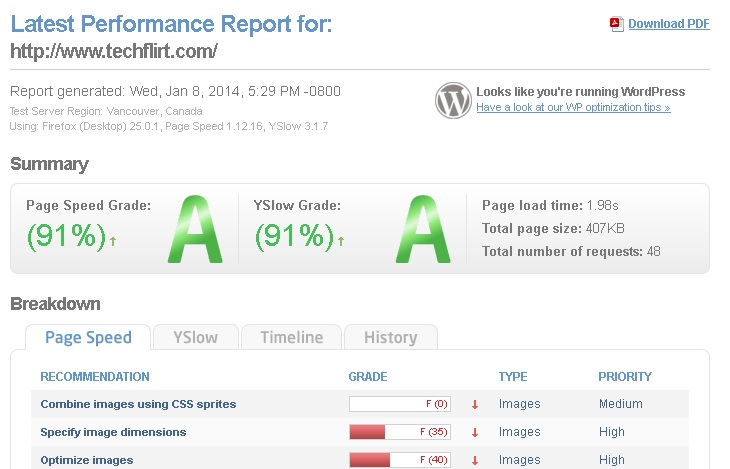
You will get following type snapshot for your website in Gtmetrix
WordPress Performance Tuning

In above snapshot you can see the following 4 tab

  1. Page Speed : In this tab you can find your website performance analysis with GooglePageSpeed.
  2. YSlow : In this tab you can find your website performance analysis with YSlow.
  3. TimeLine : In this tab you can find your website page load water fall.
  4. History: In this tab you can find previous history of your website page speed test if you did the test in in future.

Lire la suite…

Categories: Logiciel Tags: ,

Denial-of-service Attack – DoS using hping3 with spoofed IP in Kali Linux

30/04/2024 Comments off

Source: blackmoreops.com

In computing, a denial-of-service (DoS) or distributed denial-of-service (DDoS) attack is an attempt to make a machine or network resource unavailable to its intended users. Although the means to carry out, the motives for, and targets of a DoS attack vary, it generally consists of efforts to temporarily or indefinitely interrupt or suspend services of a host connected to the Internet. In this article I will show how to carry out a Denial-of-service Attack or DoS using hping3 with spoofed IP in Kali Linux.Denial-of-service-Attack-–-DoS-using-hping3-with-spoofed-IP-in-Kali-Linux-blackMORE-Ops-51

As clarification, distributed denial-of-service attacks are sent by two or more persons, or bots, and denial-of-service attacks are sent by one person or system. As of 2014, the frequency of recognized DDoS attacks had reached an average rate of 28 per hour.

Perpetrators of DoS attacks typically target sites or services hosted on high-profile web servers such as banks, credit card payment gateways, and even root nameservers.

Denial-of-service threats are also common in business, and are sometimes responsible for website attacks.

This technique has now seen extensive use in certain games, used by server owners, or disgruntled competitors on games, such as popular Minecraft servers. Increasingly, DoS attacks have also been used as a form of resistance. Richard Stallman has stated that DoS is a form of ‘Internet Street Protests’. The term is generally used relating to computer networks, but is not limited to this field; for example, it is also used in reference to CPU resource management.

One common method of attack involves saturating the target machine with external communications requests, so much so that it cannot respond to legitimate traffic, or responds so slowly as to be rendered essentially unavailable. Such attacks usually lead to a server overload. In general terms, DoS attacks are implemented by either forcing the targeted computer(s) to reset, or consuming its resources so that it can no longer provide its intended service or obstructing the communication media between the intended users and the victim so that they can no longer communicate adequately.

Denial-of-service attacks are considered violations of the Internet Architecture Board’s Internet proper use policy, and also violate the acceptable use policies of virtually all Internet service providers. They also commonly constitute violations of the laws of individual nations.

hping3 works well if you have other DoS tools such as GoldenEye running (using multiple tools that attacks same site/server/service increases the chances of success). There are agencies and corporations to runs DoS attack map in Realtime. that shows worldwide DDoS attacks almost in realtime.

Lire la suite…

PHP MySQL Benchmark Tool (PMBT v. 0.2)

19/02/2024 Comments off

Source: Reasons Unbeknownst

The old saying “Need is the father of innovation” (or something like that) held true this weekend. I was looking for an easy way to benchmark MySQL for some RAM drive InnoDB experimentation but couldn’t find anything cross platform, user friendly, and created after 2005. So I built an early version of what I was looking for.

This is a very synthetic benchmark for now. In some instances InnoDB is much faster than MyISAM (simultaneous reads/writes) but that doesn’t come across in these results. I’m planning on beefing up the benchmark options in later versions. This tool is currently useful in benchmarking hard drive / RAID performance when using InnoDB. It’s also good for basic my.cnf tweaking. Lire la suite…

Increase PHP memory limit

16/02/2024 Comments off

note: increasing PHP memory limit is different from increasing PHP upload size. You can learn to increase upload size here.

A PHP memory limit of 32MB is the minimum requirement for Drupal 7 (16MB for Drupal 6), and 64MB is recommended. Some sites may need more than 64MB if they are using certain contributed modules such as Views and Panels. Memory limits of 128MB and higher are not unusual. There are several techniques to increase the PHP memory limit and you only need to use one of them. The right one for you depends on your system configuration.
Lire la suite…

Categories: Logiciel Tags: , ,

PHP accélérateurs : eAccelerator XCache ionCube Nusphere APC MemCache (cache PHP)

15/02/2024 Comments off

Selon leur système de cache, quel est le meilleur accélérateur de code PHP ?

Les différents PHP cache accélérateur

Les accélérateurs maintenus

APC

APC — Cache PHP alternatif

Le « Alternative PHP Cache » (APC) est un cache d’opcode libre et ouvert pour PHP permetant d’optimiser le code PHP et le cache de données et le code compilé PHP depuis le compilateur bytecode en mémoire partagée. Il a été conçu afin de fournir un framework libre, ouvert et robuste pour la mise en cache et l’optimisation de code intermédiaire PHP. (extension PECL, incluse en standard à partir de PHP6)

eAccelerator

eAccelerator est né en Décembre 2004 comme une branche de Turck MMCache projet. Turck MMCache a été créé par Dmitry Stogov et une grande partie de la eAccelerator code est toujours fondée sur son travail. eAccelerator contenait également un codeur PHP et chargeur, mais le développement personnel de l’encodeur abandonnées et ont supprimé cette fonction après Décembre 2006.
Lire la suite…

Categories: Logiciel Tags: , ,