Archive

Archives pour la catégorie ‘Système’

Linux Security Basics

22/04/2024 Comments off

One of the most daunting prospects of administering your own server on a public network is dealing with your server’s security. While security threats in a networked world are real and it is always important to be mindful of security issues, protecting against possible attacks is often a matter of exercising basic common sense and adhering to some general best practices.

This guide takes a broad overview of common security concerns and provides a number of possible solutions to common security problems. You are encouraged to consider deploying some of these measures to “harden” your server against possible attacks.

It’s important to remember that all of the solutions we present in this document are targeted at specific kinds of attacks, which themselves may be relevant only in specific configurations. Security solutions need to be tailored to the kind of services that you’re providing and the software you’re running, and the decision whether or not to deploy a specific security solution is often a matter of personal discretion and cost-benefit analysis.

Perhaps most importantly, it should be understood that security is a process, not a product (credit to Bruce Schneier.) There is no “magic bullet” set of guidelines that can be followed to ensure the security of any system. Threats are constantly evolving, so vigilance is required on the part of network administrators to prevent unauthorized access to systems.

Keep Systems and Software Up To Date

One of the most significant sources of security vulnerabilities are systems running out of date software with known security holes. Make a point of using your system’s package management tools to keep your software up to date; this will greatly assist in avoiding easily preventable security intrusions.

Running system updates with the package management tool, using apt-get update && apt-get upgrade (for Debian and Ubuntu Systems) or yum update (for CentOS and Fedora systems) is simple and straightforward. This practice ensures that if your distribution maintains active security updates, your system will be guarded against many security holes in commonly used software packages.

System update tools will, however, not keep software up to date that you’ve installed outside of package management. This includes software that you’ve compiled and installed “by hand” (e.g. with ./configure && make && make install) and web-based applications that you’ve installed from a software developer’s site, as is often the case with applications like WordPress and Drupal. Also excluded from protection will be libraries and packages you’ve installed with supplementary package management tools like Ruby’s Gems, Perl’s CPAN tool, Python easy_install, and Haskell Cabal. You will have to manage the process of keeping these files up to date yourself.

The method you use to make sure that your entire system is kept up to date is a matter of personal preference, and depends on the nature of your workflow. We would recommend trying very hard to use the versions of software provided by your operating system or other programming platform-specific package management tools. If you must install from “source,” we would recommend that you save the tarballs and source files for all such software in /src/ or ~/src/ so that you can keep track of what software you’ve installed in this manner. Often, you can remove a manually compiled application by issuing make uninstall in the source repository (directory). Additionally, it may be helpful to maintain a list of manually installed software, with version numbers and download locations. You may also want to investigate packaging your own software so that you can install it with apt, yum or pacman.

Because of the complexity of maintaining software outside of the system’s package management tools we strongly recommend avoiding manually installing software unless absolutely necessary. Your choice in a Linux distribution should be heavily biased by the availability of software in that distro’s repositories for the systems you need to run on your server.

Lire la suite…

Websync, web interface to manage your rsync tasks

20/04/2024 Comments off

Source: freedif.org

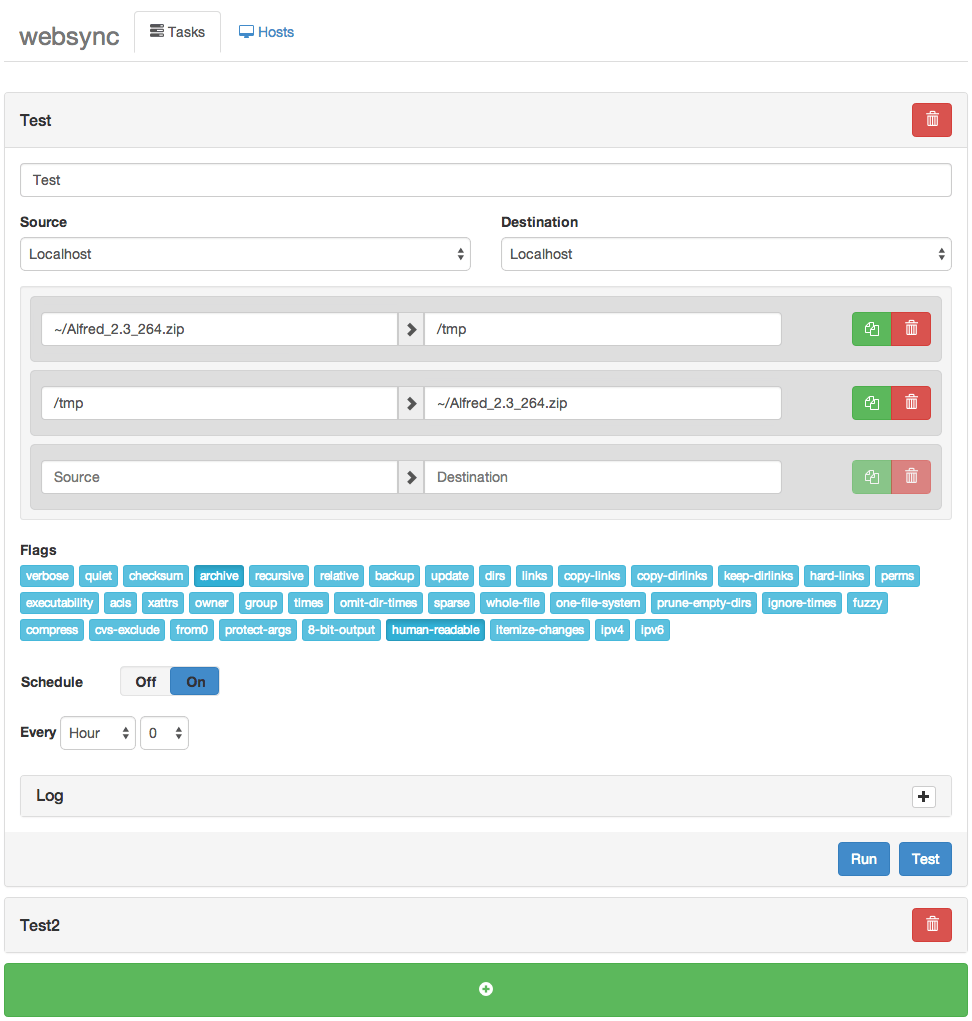
tasks_tabRsync is a great tool to replicate, sync some data on your computer. And I’m heavily relying on it to backup my server and to mirror some opensource projects and GNU/Linux Distributions.

But I’ve recently found a Web interface to manage all my rsync tasks called websync.

Websync is a web based rsync task manager where you can add, edit, clone, remove, scheduled,…. your rsync tasks while being able to have a remote host as source or destination of the task (With SSH RSA key too)

Under the free license MIT, Websync has been developped by Sander Struijk and is still actively being maintained, as you can see on github forum. But it is still an early project, so if you face any issue, make sure to report them on the issue tracker.

Interested to give it a shot, here is how to install Websync!

Lire la suite…

Categories: Logiciel, Système Tags: , , ,

How to Backup Linux? 15 rsync Command Examples

20/04/2024 Comments off

Source: TheGeekStuff

rsync-commandrsync stands for Remote SYNC.

rsync is used to perform the backup operation in UNIX / Linux.

rsync utility is used to synchronize the files and directories from one location to another in an effective way. Backup location could be on local server or on remote server.

Important features of rsync

  • Speed: First time, rsync replicates the whole content between the source and destination directories. Next time, rsync transfers only the changed blocks or bytes to the destination location, which makes the transfer really fast.
  • Security: rsync allows encryption of data using ssh protocol during transfer.
  • Less Bandwidth: rsync uses compression and decompression of data block by block at the sending and receiving end respectively. So the bandwidth used by rsync will be always less compared to other file transfer protocols.
  • Privileges: No special privileges are required to install and execute rsync

Syntax

$ rsync options source destination

Source and destination could be either local or remote. In case of remote, specify the login name, remote server name and location.
Lire la suite…

Categories: Système Tags: , , , ,

Rsync (Remote Sync): 10 Practical Examples of Rsync Command in Linux

18/04/2024 Comments off

Source: tecmint.com (Tarunika Shrivastava)

Rsync (Remote Sync) is a most commonly used command for copying and synchronizing files and directories remotely as well as locally in Linux/Unix systems. With the help of rsync command you can copy and synchronize your data remotely and locally across directories, across disks and networks, perform data backups and mirroring between two Linux machines.

This article explains 10 basic and advanced usage of the rsync command to transfer your files remotely and locally in Linux based machines. You don’t need to be root user to run rsync command.

Some advantages and features of Rsync command
  1. It efficiently copies and sync files to or from a remote system.
  2. Supports copying links, devices, owners, groups and permissions.
  3. It’s faster than scp (Secure Copy) because rsync uses remote-update protocol which allows to transfer just the differences between two sets of files. First time, it copies the whole content of a file or a directory from source to destination but from next time, it copies only the changed blocks and bytes to the destination.
  4. Rsync consumes less bandwidth as it uses compression and decompression method while sending and receiving data both ends.
Basic syntax of rsync command
# rsync options source destination

Lire la suite…

Categories: Système Tags: , ,

compgen: An Awesome Command To List All Linux Commands

16/04/2024 Comments off

Source: nixCraft

Ever want to list all the Linux commands (including bash shell aliases and functions) you could run on the server / workstation? Look now further. Try compgen command.

compgen is bash built-in command and it will show all available commands, aliases, and functions for you. The syntax is:

compgen option

compgen command examples

To list all the commands available to you, enter:

 
compgen -c

Sample outputs:

ls
if
then
else
elif
fi
....
mahjongg
sol
gtali
sl-h
gnobots2
gnotravex
iagno
fortune
gnect
gnome-sudoku
LS
glchess
gnuchess
gnuchessx

You can search or count the commands:

compgen -c | grep find
compgen -c | wc -l
echo "$USER user can run $(compgen -c | wc -l) commands on $HOSTNAME."

Lire la suite…

Categories: Système Tags: ,