Archive

Archives pour la catégorie ‘Logiciel’

How to convert .rmvb to .avi (on PowerPC and Intel Macs)?

06/02/2024 Comments off

The good news is it’s very easy. The bad news is you’ll need a PowerPC Mac.A big thank you to Bluemint for pointing out an Universal Binaries version of the Real Codec is actually available, making the conversion possible on both PowerPC and Intel Mac. The instructions below are herewith updated.

What you’ll need:

  1. ffmpegX – It’s a Mac OS X graphic user interface designed to easily operate more than 20 powerful Unix open-source video and audio processing tools
  2. mpeg2enc – Download to your Downloads folder.
  3. mencoder & mplayer – Download and decompress the zip file.

Setup:

The first time you launch ffmpegX it’ll ask you to locate three components (items 2 & 3 above). Click on the respective “Locate” buttons to tell ffmpegX where they are. After that, enter your Mac OS X login password (ffmpegX won’t work if your login password is empty) and click the “Install” button.

Download and Install the Real Codec (Universal Binaries)

  1. Download the “Mac OS X x86″ binary codec package from one of these links on this page.
  2. Unzip the downloaded zip file and install the codec package.
  3. Select “Go to folder …” from Finder’s “Go” menu.
  4. Type “/usr/local/lib/” in the input text field and click “Go”
  5. You should see a “codecs” folder in the new window.
  6. Drag the “codecs” folder to your Desktop, and rename it to “reallib”.
  7. Move the “reallib” folder to “/Library/Applications Support/ffmpegx/”.

Performing the conversion to .avi

UB Rockz on any valid unicode Path/Filename.
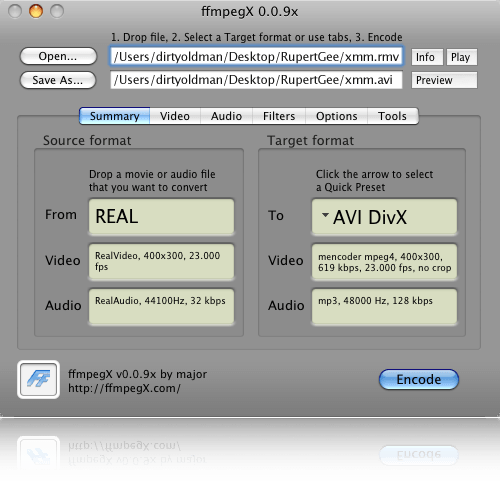
ffmpegx-rmvb
Drag and drop your rmvb file into the “From” well and just click the “Encode” button to start encoding. Unless you’re an expert user, do not be tempted to change any settings when converting a .rmvb file.

In other words, for a successful run, just drag, drop, and click Encode. What more can you ask for?

Footnotes:

  • Re-launch ffmpegX if you messed up the default settings.
  • You can close ffmpegX’s main window after clicking Encode; a new stand-alone Progress window shows you the progress.
  • Repeat the process to convert more files.
  • The “Play” button plays the .rmvb.
  • The “Preview” button plays the (partially) converted .avi file.
  • Press the Return key to stop playback.
  • You can download and install MPlayer to play your .rmvb files. However, it has a bug whereby it only plays video and totally ignores embedded links and other wonderful added features Real is famous for.
Categories: Logiciel, Système Tags: , ,

Postfix + fail2ban = win

05/02/2024 Comments off
source: http://blog.dp.cx/25/postfix-fail2ban-win

Recently, I had to lease a new server. My old one was ok, but it was 5 years old, and showing it’s age. The most recent bout of problems was due to postfix, and a specific domain that I host mail for.

I had previously set up Policyd in an attempt to stop the influx of spam before it ever hit the server, but it wasn’t doing anything at this point. So approximately 800 messages per minute were getting directly to Postfix, and then running queries against MySQL (I use virtual maps for users, aliases, domains, etc). 99% of these messages were to non-existant users, so Postfix would bounce them. But the little 2.0GHz Celeron couldn’t handle it. The load shot up to 8 for around 3 weeks, and stayed there. I wish the fail2ban idea had come to me sooner… Lire la suite…

Auto-hébergement: YunoHost Bêta 1 est disponible

05/02/2024 Comments off

Source: linuxfr.org

La distribution home-serveur YunoHost, basée sur Debian, a sortie le 31/05/12 sa première version publique. Encore en développement intensif, la Bêta 1 nous donne un avant-goût de ce qui a pour but de devenir une distribution serveur grand public.

Au programme de cette version : Un serveur mail, XMPP et LAMP auto-configuré à base de LDAP, ainsi qu’une installation simplifiée par rapport au standard Debian.

Un développement expéditif

C’est lors d’un constat alarmant de l’état de l’auto-hébergement en France que les deux développeurs du projet ont décidé de réagir: L’auto-hébergement peut être bénéfique au plus grand nombre mais reste très difficile d’accès, et des initiatives comme Beedbox ou Freedombox peinent à voir le jour.

Ainsi, 3 mois de développement auront suffit à l’administrateur système et au développeur web en charge du projet pour sortir cette première Bêta. Bien sûr, beaucoup de travail reste à faire avant que Madame Michu ne relève ses mails sur son propre serveur, mais l’idée était avant tout de proposer un support sur lequel baser une communauté de contributeurs motivés.

Techniquement

La distribution inclut par défaut les composants standards Debian suivant :

  • Apache 2
  • MySQL
  • PHP
  • Postfix
  • Dovecot
  • Ejabberd
  • OpenLDAP

Elle utilise LemonLDAP::NG comme SSO, et le reste sont des paquets YunoHost disponible par un dépôt Debian dédié.

Lors de l’installation, tous les services sont configurés pour fonctionner avec l’annuaire LDAP, et une interface d’administration Web (« admin.mondomaine.fr ») permet de gérer, entre autre, les utilisateurs de celui-ci.

Les développeurs ont également mis en place un système d’installation automatique d’applications web, sous forme de paquets Debian également, et installables depuis l’interface web. Un portail d’application devient ensuite accessible par l’URL « apps.mondomaine.fr », et bénéficie de l’authentification unique de LemonLDAP.

Encore des lacunes

Toujours dans un souci de « Release early, release often » (sortir tôt, sortir souvent), l’équipe a concédé plusieurs lacunes importantes techniquement :

D’une part, l’interface web d’administration est codée en PHP et permet un large choix d’opérations serveurs (installation de paquet, redémarrage de services, consultation de logs), ce qui peut et pourra présenter de conséquentes failles de sécurité.
D’autre part, certains composants intégrés sont assez gourmand en ressources (Apache, Ejabberd et MySQL en particulier), ce qui oblige un utilisateur modeste à disposer d’un minimum de 512Mo de mémoire vive pour faire tourner correctement la distribution.
Enfin, le SSO LemonLDAP::NG – bien que très fonctionnel – restreint l’architecture requise aux processeurs x86 uniquement, ce qui empêche pour le moment la distribution de s’installer sur des NAS ou autres boîtiers ARM.

Categories: Logiciel, Système Tags: , , ,

Surveillance système des machines sur un réseau avec Munin

04/02/2024 Comments off

I. Introduction

muninMunin est un outil de surveillance basé sur le célèbre RRDTool, permettant de connaître toutes les données systèmes des autres ordinateurs du réseau. Il les présente automatiquement sous forme de graphiques consultables depuis une page web. Par ailleurs, il dispose d’un système de plugins qui le rend simple d’utilisation et très modulaire.

J’ai choisi de le présenter, et non certains de ses concurrents comme Nagios, Cacti ou Zabbix, car il m’a semblé être le plus simple d’utilisation tout en conservant de fortes possibilités d’adaptation.

Un système Munin est composé de :

  • un serveur principal, récupérant les informations
  • un nœud par équipement à surveiller

Il faut signaler qu’avec une telle architecture Munin se différencie de Nagios. Ce dernier préfère en effet centraliser toutes les mesures sur le serveur, ce qui permet de ne rien installer sur les équipements surveillés.

Lire la suite…

Fixing Apache after Ubuntu 13.10 upgrade

01/02/2024 Comments off

Ubuntu 13.10 was released yesterday. As well as other package updates, it includes an upgrade from Apache 2.2 to 2.4, which broke a few things on my dev machine.

After the upgrade I was getting the standard « It works! » Apache message on all of my virtual hosts. Running apache2ctl configtest gave me the familiar warning:

Could not reliably determine the server’s fully qualified domain name, using 127.0.1.1. Set the ‘ServerName’ directive globally to suppress this message

You often get this error in an out-of-the-box Ubuntu setup as you need to tell Apache what hostname to use as the default. I’d previously fixed this by creating a config file at /etc/apache2/conf.d/fqdn that contains only:

ServerName localhost

so first I had to investigate why this was no longer working. It turned that Apache 2.4 no longer reads configs from conf.d. If you check the end of apache2.conf, you’ll see that it now looks in a folder called conf-enabled instead:

# Include generic snippets of statements
IncludeOptional conf-enabled/*.conf

This folder contains symlinked files pointing at conf-available, making the conf setup similar to the approach used for vhosts. So, to fix the error I moved all of my configuration files from conf.d to /etc/apache2/conf-available/, added a .conf file extension to each one, and then ran:

a2enconf fqdn

to setup the symlink.

After restarting Apache, the FQDN error was gone, but I was still getting the « It works! » message for all my vhosts. I had another look at the main Apache config and found:

# Include the virtual host configurations:
IncludeOptional sites-enabled/*.conf

So by default Apache expects the vhost files to have a .conf file extension (which it didn’t before). Mine just used the hostname as the filename. So I renamed each of these and updated the symlinks that point to them.

After that everything was back to normal.

A full 2.2 to 2.4 upgrade guide is available in case you have any other issues. Of particular note is the change to the syntax for ‘Deny from’ and ‘Require’, so if you start getting « 403 Forbidden » errors on things that previously worked you’ll probably need to update those directives.

Many/all of these issues could be mitigaged by either keeping old configs during the upgrade or by installing the provided compatibility module, but in development I prefer to always install package maintainer’s configs when upgrading so that I know how to fix things if they were to go wrong in production.

Categories: Logiciel, Système Tags: , ,