Les bases de données SQL et plus particulièrement MySQL restent une des pierres angulaires de l’immense majorité des sites internet. MySQL fonctionne très bien out of the box, cependant, dès que la base se trouve assez sollicitée, on s’aperçoit que les réglages par défaut méritent une petite optimisation. Jetons un œil à tout ça !
Récemment, un des serveurs de Peerus commençait à avoir de sacrés pics de load lors des heures de forte charge, avec MySQL pour principal responsable. Une grosse centaine de connexions simultanées et quelques dizaines de requêtes par seconde sur des bases de plusieurs dizaines de giga. C’est un peu plus que le WordPress moyen, mais rien d’ingérable pour un MySQL bien réglé.
Dès lors, avant d’imaginer prendre un serveur plus puissant, sharder les tables ou je ne sais quoi encore, il faut tirer le maximum de notre cher SGBDR. Lire la suite…
One means of restricting client use of MySQL server resources is to set the global max_user_connections system variable to a nonzero value. This limits the number of simultaneous connections that can be made by any given account, but places no limits on what a client can do once connected. In addition, settingmax_user_connections does not enable management of individual accounts. Both types of control are of interest to MySQL administrators.
To address such concerns, MySQL permits limits for individual accounts on use of these server resources:
The number of queries an account can issue per hour
The number of updates an account can issue per hour
The number of times an account can connect to the server per hour
The number of simultaneous connections to the server by an account
Any statement that a client can issue counts against the query limit, unless its results are served from the query cache. Only statements that modify databases or tables count against the update limit.
An “account” in this context corresponds to a row in the mysql.user table. That is, a connection is assessed against the User and Host values in the user table row that applies to the connection. For example, an account 'usera'@'%.example.com' corresponds to a row in the user table that has User and Host values of usera and %.example.com, to permit usera to connect from any host in the example.com domain. In this case, the server applies resource limits in this row collectively to all connections by usera from any host in the example.com domain because all such connections use the same account.
Before MySQL 5.0.3, an “account” was assessed against the actual host from which a user connects. This older method of accounting may be selected by starting the server with the --old-style-user-limits option. In this case, if usera connects simultaneously from host1.example.com andhost2.example.com, the server applies the account resource limits separately to each connection. If usera connects again from host1.example.com, the server applies the limits for that connection together with the existing connection from that host.
To establish resource limits for an account at account-creation time, use the CREATE USER statement. To modify the limits for an existing account, use ALTER USER. (Before MySQL 5.7.6, use GRANT, for new or existing accounts.) Provide a WITH clause that names each resource to be limited. The default value for each limit is zero (no limit). For example, to create a new account that can access the customer database, but only in a limited fashion, issue these statements:
mysql> CREATE USER 'francis'@'localhost' IDENTIFIED BY 'frank'
    ->     WITH MAX_QUERIES_PER_HOUR 20
    ->          MAX_UPDATES_PER_HOUR 10
    ->          MAX_CONNECTIONS_PER_HOUR 5
    ->          MAX_USER_CONNECTIONS 2;
The limit types need not all be named in the WITH clause, but those named can be present in any order. The value for each per-hour limit should be an integer representing a count per hour. For MAX_USER_CONNECTIONS, the limit is an integer representing the maximum number of simultaneous connections by the account. If this limit is set to zero, the global max_user_connections system variable value determines the number of simultaneous connections. Ifmax_user_connections is also zero, there is no limit for the account.
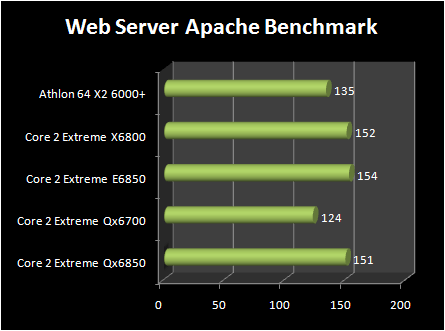
You can benchmark Apache, IIS and other web server with apache benchmarking tool called ab. Recently I was asked to performance benchmarks for different web servers.
Apache benchmark
It is true that benchmarking a web server is not an easy task. From how to benchmark a web server:
First, benchmarking a web server is not an easy thing. To benchmark a web server the time it will take to give a page is not important: you don’t care if a user can have his page in 0.1 ms or in 0.05 ms as nobody can have such delays on the Internet.
What is important is the average time it will take when you have a maximum number of users on your site simultaneously. Another important thing is how much more time it will take when there are 2 times more users: a server that take 2 times more for 2 times more users is better than another that take 4 times more for the same amount of users. »
Here are few tips to carry out procedure along with an example:
Apache Benchmark Procedures
You need to use same hardware configuration and kernel (OS) for all tests
You need to use same network configuration. For example, use 100Mbps port for all tests
First record server load using top or uptime command
Take at least 3-5 readings and use the best result
After each test reboot the server and carry out test on next configuration (web server)
Again record server load using top or uptime command
Carry on test using static html/php files and dynamic pages
It also important to carry out test using the Non-KeepAlive and KeepAlive (the Keep-Alive extension to provide long-lived HTTP sessions, which allow multiple requests to be sent over the same TCP connection) features
Also don’t forget to carry out test using fast-cgi and/or perl tests
How can I use dd command on a Linux to test I/O performance of my hard disk drive? How do I check the performance of a hard drive including the read and write speed on a Linux operating systems?
You can use the following commands on a Linux or Unix-like systems for simple I/O performance test:
dd command : It is used to monitor the writing performance of a disk device on a Linux and Unix-like system.
hdparm command : It is used to get/set hard disk parameters including test the reading and caching performance of a disk device on a Linux based system.
In this tutorial you will learn how to use the dd command to test disk I/O performance.
Use dd command to monitor the reading and writing performance of a disk device:
Open a shell prompt.
Or login to a remote server via ssh.
Use the dd command to measure server throughput (write speed)