How to secure SSH login with one-time passwords on Linux
As someone says, security is a not a product, but a process. While SSH protocol itself is cryptographically secure by design, someone can wreak havoc on your SSH service if it is not administered properly, be it weak passwords, compromised keys or outdated SSH client.
As far as SSH authentication is concerned, public key authentication is in general considered more secure than password authentication. However, key authentication is actually not desirable or even less secure if you are logging in from a public or shared computer, where things like stealth keylogger or memory scraper can always a possibility. If you cannot trust the local computer, it is better to use something else. This is when « one-time passwords » come in handy. As the name implies, each one-time password is for single-use only. Such disposable passwords can be safely used in untrusted environments as they cannot be re-used even when they are stolen.
One way to generate disposable passwords is via Google Authenticator. In this tutorial, I am going to demonstrate another way to create one-time passwords for SSH login: OTPW, a one-time password login package. Unlike Google Authenticator, you do not rely on any third party for one-time password generation and verification.
What is OTPW?
OTPW consists of one-time password generator and PAM-integrated verification routines. In OTPW, one-time passwords are generated apriori with the generator, and carried by a user securely (e.g., printed in a paper sheet). Cryptographic hash of the generated passwords are then stored in the SSH server host. When a user logs in with a one-time password, OTPW’s PAM module verifies the password, and invalidates it to prevent re-use.
Step One: Install and Configure OTPW on Linux
Debian, Ubuntu or Linux Mint:
Install OTPW packages with apt–get.
$ sudo apt-get install libpam-otpw otpw-bin
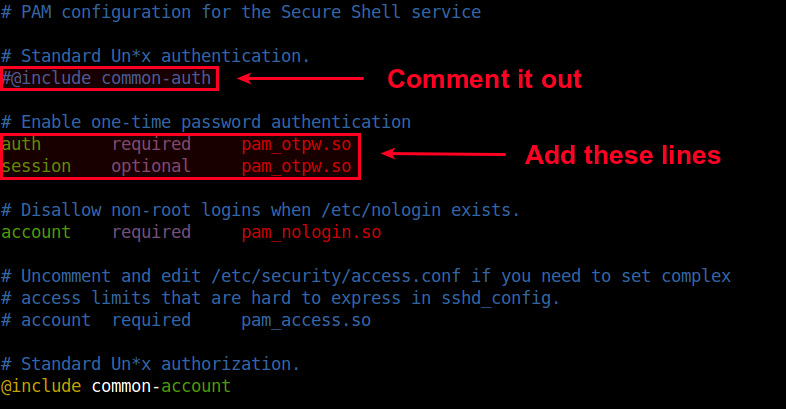
Open a PAM configuration file for SSH (/etc/pam.d/sshd) with a text editor, and comment out the following line (to disable password authentication).
#@include common-auth
and add the following two lines (to enable one-time password authentication):
auth       required     pam_otpw.so
session    optional     pam_otpw.so
Fedora or CentOS/RHEL:
OTPW is not available as a prebuilt package on Red Hat based systems. So let’s install OTPW by building it from the source.
First, install prerequites:
$ sudo yum git gcc pam-devel
$ git clone https://www.cl.cam.ac.uk/~mgk25/git/otpw
$ cd otpw
Open Makefile with a text editor, and edit a line that starts with « PAMLIB= » as follows.
On 64-bit system:
PAMLIB=/usr/lib64/security
On 32-bit system:
PAMLIB=/usr/lib/security
Compile and install it. Note that installation will automatically restart an SSH server. So be ready to be disconnected if you are on an SSH connection.
$ make
$ sudo make install
Now you need to update SELinux policy since /usr/sbin/sshd tries to write to user’s home directory, which is not allowed by default SELinux policy. The following commands will do. If you are not using SELinux, skip this step.
$ sudo grep sshd /var/log/audit/audit.log | audit2allow -M mypol
$ sudo semodule -i mypol.pp
Next, open a PAM configuration file for SSH (/etc/pam.d/sshd) with a text editor, and comment out the following line (to disable password authentication).
#auth substack password-auth
and add the following two lines (to enable one-time password authentication):
auth       required     pam_otpw.so
session    optional     pam_otpw.so