Archive

Articles taggués ‘commands’

Fixing Mac OSX File Permissions and ACLs From the Command Line

09/01/2024 Comments off

Recently the hard drive in my mac mini running Mac OSX Leopard (10.5) failed. Luckily I had time machine backing it up to an external USB disk. Now, since I had to replace the drive and rebuild my system anyway I figured, why not upgrade to Snow Leopard? Planning to just pull what I needed off the backup drive manually I went ahead with the upgrade. There aren’t too many files on this machine that I depend on. Just some ssh keys, gpg keys and random documents scattered about here and there. So I upgraded, installed my apps and copied my files from the backup. Everything was going smoothly until I tried to actually write to one of the files I copied from the backup drive. This is when I started getting permission errors.

Here’s what happened when I tried to update my ssh known_hosts file:

airbag:~ keith$ echo foo > .ssh/known_hosts 
-bash: .ssh/known_hosts: Permission denied

Huh? But I own this file…dont I?

airbag:~ keith$ id
uid=501(keith) gid=20(staff) groups=20(staff),402(com.apple.sharepoint.group.1),204(_developer),100(_lpoperator),98(_lpadmin),81(_appserveradm),80(admin),79(_appserverusr),61(localaccounts),12(everyone),401(com.apple.access_screensharing)

airbag:~ keith$ ls -al .ssh/known_hosts 
-rw-r--r--@ 1 keith 502 56140 Mar 25 2009 .ssh/known_hosts
I do own it… And so began much head scratching and man page reading.

Well, as it turns out I forgot to look at the file ACLs…

airbag:~ keith$ ls -le .ssh/known_hosts 
-rw-r--r--@ 1 keith 502 56140 Mar 25 2009 .ssh/known_hosts
 0: group:everyone deny write,delete,append,writeattr,writeextattr,chown

Well no wonder, the ACL is set to deny write,delete,append,writeattr,writeextattr and chown from everyone! Let’s get rid of that.

airbag:~ keith$ sudo chmod -N .ssh/known_hosts 
Password:

That ought to do it. The -N flag says get rid of all the ACL info on the file. You could also update this to be just right for your user or group but I’d rather use only the standard unix permissions.

airbag:~ keith$ ls -le .ssh/known_hosts 
-rw-r--r--@ 1 keith 502 56140 Mar 25 2009 .ssh/known_hosts

Seems to have removed all ACLs from the file. I wonder if we can write to it now…

airbag:~ keith$ echo foo >> .ssh/known_hosts 
airbag:~ keith$

And there you have it, the file is writable once again. Now its time to get some real work done!
Categories: Système Tags: , , , ,

Change & Set the Default crontab Editor

08/01/2024 Comments off


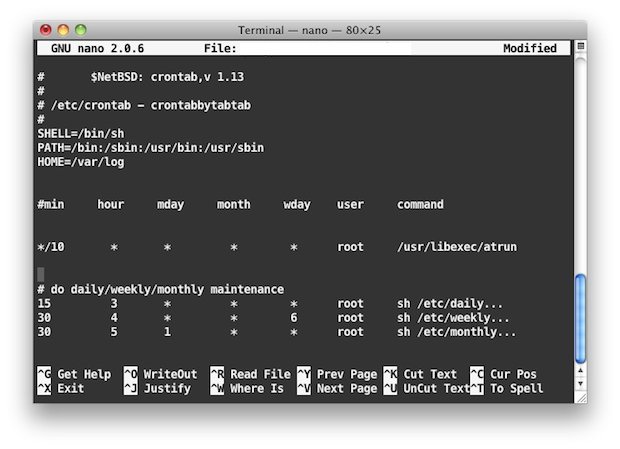
Most hardcore command line users and unix geeks love vi, but I prefer nano. If you want to change your default crontab editor to nano, here’s how to do this:

For a one time edit, launch the terminal and type:

EDITOR=nano crontab -e

If you want to set nano as your default editor in general, you use this command:

export EDITOR=nano

Now when you go to edit crontab, nano will be the default editor than vi. You can test this by typing:

crontab -e

Looking beyond Mac OS X, this should work in Linux as well.

Categories: Système Tags: , , , ,

Chercher une chaine de caractères dans des fichiers Linux

04/01/2024 Comments off

Source: tuto-linux.com

Sur Linux, ne vous est-il jamais arrivé de vouloir chercher une chaîne de caractères dans un dossier complet, autrement dit une multitude de fichiers ?

Et bien croyez-moi, si un jour vous devez chercher une adresse email, une adresse IP, un bout de code, ou autre, dans plusieurs milliers de fichiers, cette commande vous épargnera un gros travail manuel.

Placez vous dans le répertoire dans lequel vous souhaitez rechercher une chaîne de caractères. Et tapez la commande suivante :

find . -name "*" -exec grep -Hn "trouvemoi" {} \;

En remplaçant trouvemoi par ce que vous cherchez.

Par exemple, si vous cherchez une adresse IP dans tous vos fichiers logs à la fois, vous ferez (ne tapez que ce qui se trouve après le #) :

monlinux / # cd /var/log
monlinux log # find . -name "*" -exec grep -Hn "192.168.0.1" {} \;

Une autre technique consiste à utiliser « rgrep » qui va effectuer un « grep » récursif à partir du dossier dans lequel on se trouve et dans toute l’arborescence descendante.

Categories: Système Tags: ,

Alertes par SMS en Bash (via Google Calendar)

03/01/2024 Comments off

La remontée d’alerte par SMS (“Short Message Service”) est un plus non négligeable dans le monitoring de systèmes d’informations critiques.

Les services gratuits permettant d’utiliser les SMS depuis le système restent rare.

Depuis plusieurs années déjà, “Google Agenda” propose à ses clients des rappels de rendez-vous par SMS.
Rapidement, ce service Google fût détourné pour être utilisé comme source de remontée d’alertes (exemple : “SmsAlert : Envoyer des SMS gratuitement depuis ses serveurs” sur le site Macsim’s Mind qui utilisait le script PHP d’ Alexander Skakunov pour remonter des alertes par SMS).

Bien que très efficaces, la plupart de ces détournement sont implémentés en PHP qui n’est pas installé sur tous les serveurs.

L’idée de cet article et d’utiliser la même technique mais implémentée en BASH.

Principe de fonctionnement

Le principe est de créer un événement dans un agenda Google Calendar débutant dans 5 minutes et X secondes et d’avertir l’administrateur par SMS 5 minutes avant le début de l’événement. Le SMS sera donc envoyé après X secondes.

L’objectif du script “googalert” (disponible sur sourceforge) est de n’utiliser que des commandes classiques du shell, de pouvoir choisir l’agenda dans lesquels seront stockés les alertes et d’être parfaitement conforme à l’API Google(http://www.udel.edu/CIS/software/dist/google/calendar/java.client/gdata/doc/calendar.htmlvoir Add an event).

Lire la suite…

Categories: Système Tags: , , ,

How to check the file size in Linux/Unix bash shell scripting

22/12/2023 Comments off


How to check file size in unix using wc command

The wc command shows the number of lines, words, and bytes contained in file. The syntax is as follows to get the file size:
wc -c /path/to/file
wc -c /etc/passwd

Sample outputs:

5253 /etc/passwd

You can easily extract the first field either using the cut or awk command:
wc -c /etc/passwd | awk '{print $1}'
Sample outputs:

5253

OR assign this size to a bash variable:

myfilesize=$(wc -c "/etc/passwd" | awk '{print $1}')
printf "%d\n" $myfilesize
echo "$myfilesize"

How to get the size of a file in a bash script using stat command

The stat command shows information about the file. The syntax is as follows to get the file size on GNU/Linux stat:
stat -c %s "/etc/passwd"
OR
stat --format=%s "/etc/passwd"
To assign this size to a bash variable:

myfilesize=$(stat --format=%s "/etc/passwd")
echo "$myfilesize"
## or ##
myFileSizeCheck=$(stat -c %s "/etc/resolv.conf")
printf "My file size = %d\n" $myFileSizeCheck

The syntax is as follows to get the file size on BSD/MacOS stat:
stat -f %z "/etc/passwd"
Please note that if the file is symlink you will get size of that link only with the stat command.

du command example

The syntax is

du --apparent-size --block-size=1  "/etc/passwd"
fileName="/etc/hosts"
mfs=$(du --apparent-size --block-size=1  "$fileName" | awk '{ print $1}')
echo "$fileName size = ${mfs}"

Sample outputs from above commands:

Fig.01: How to check size of a file using a bash/ksh/zsh/sh/tcsh shell?Fig.01: How to check size of a file using a bash/ksh/zsh/sh/tcsh shell?


Find command example

The syntax is:

find "/etc/passwd" -printf "%s"
find "/etc/passwd" -printf "%s\n"
fileName="/etc/hosts"
mysize=$(find "$fileName" -printf "%s")
printf "File %s size = %d\n" $fileName $mysize
echo "${fileName} size is ${mysize} bytes."
Categories: Système Tags: , , , ,