One of the interesting new tools in MySQL 5.1.4 is mysqlslap, a load emulator that lets you see how well a particular query set or table engine performs under high-load conditions.
A query that consumes too many database resources may be the result of designing tables incorrectly, choosing the wrong table type, or creating an inefficient query. When a query eats up a lot of database resources, it can negatively affect other application components. By using mysqlslap to stress test a server in a non-public environment, you will discover these errors sooner, allowing you to you avoid a database meltdown once your application goes live.
This tutorial shows how you can use mysqlslap to run stress tests involving multiple clients, custom queries, different table engines, and much more. Lire la suite…
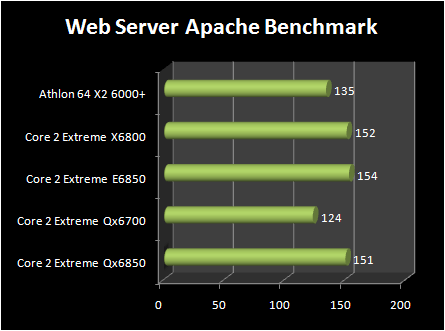
You can benchmark Apache, IIS and other web server with apache benchmarking tool called ab. Recently I was asked to performance benchmarks for different web servers.
Apache benchmark
It is true that benchmarking a web server is not an easy task. From how to benchmark a web server:
First, benchmarking a web server is not an easy thing. To benchmark a web server the time it will take to give a page is not important: you don’t care if a user can have his page in 0.1 ms or in 0.05 ms as nobody can have such delays on the Internet.
What is important is the average time it will take when you have a maximum number of users on your site simultaneously. Another important thing is how much more time it will take when there are 2 times more users: a server that take 2 times more for 2 times more users is better than another that take 4 times more for the same amount of users. »
Here are few tips to carry out procedure along with an example:
Apache Benchmark Procedures
You need to use same hardware configuration and kernel (OS) for all tests
You need to use same network configuration. For example, use 100Mbps port for all tests
First record server load using top or uptime command
Take at least 3-5 readings and use the best result
After each test reboot the server and carry out test on next configuration (web server)
Again record server load using top or uptime command
Carry on test using static html/php files and dynamic pages
It also important to carry out test using the Non-KeepAlive and KeepAlive (the Keep-Alive extension to provide long-lived HTTP sessions, which allow multiple requests to be sent over the same TCP connection) features
Also don’t forget to carry out test using fast-cgi and/or perl tests