Archive

Articles taggués ‘bash’

Bash: How do I get the command history in a screen session?

16/12/2023 Comments off

If I start a screen session with screen -dmS name, how would I access the command history of that screen session with a script?

Using the ↑, the last executed command appears, even in screen.

ANSWER:

I use the default bash shell on my system and so might not work with other shells.

this is what I have in my ~/.screenrc file so that each new screen window gets its own command history:

Default Screen Windows With Own Command History

To open a set of default screen windows, each with their own command history file, you could add the following to the ~/.screenrc file:

screen -t "window 0" 0 bash -ic 'HISTFILE=~/.bash_history.${WINDOW} bash'
screen -t "window 1" 1 bash -ic 'HISTFILE=~/.bash_history.${WINDOW} bash'
screen -t "window 2" bash -ic 'HISTFILE=~/.bash_history.${WINDOW} bash'

Ensure New Windows Get Their Own Command History

The default screen settings mean that you create a new window using Ctrl+a c or Ctrl+a Ctrl+c. However, with just the above in your ~/.screenrc file, these will use the default ~/.bash_history file. To fix this, we will overwrite the key bindings for creating new windows. Add this to your ~/.screenrc file:

bind c screen bash -ic 'HISTFILE=~/.bash_history.${WINDOW} bash'
bind ^C screen bash -ic 'HISTFILE=~/.bash_history.${WINDOW} bash'

Now whenever you create a new screen window, it’s actually launching a bash shell, setting the HISTFILE environmental variable to something that includes the current screen window’s number ($WINDOW).

Command history files will be shared between screen sessions with the same window numbers.

Write Commands to $HISTFILE on Execution

As is normal bash behavior, the history is only written to the $HISTFILE file by upon exiting the shell/screen window. However, if you want commands to be written to the history files after the command is executed, and thus available immediately to other screen sessions with the same window number, you could add something like this to your ~/.bashrc file:

export PROMPT_COMMAND="history -a; history -c; history -r; ${PROMPT_COMMAND}"
Categories: Système Tags: , ,

Learn Bash: Remove Commands From Your History

15/12/2023 Comments off

Occasionally I type a password or other sensitive information into a shell prompt. Using bash history, the command can be removed.

# say we start with an empty bash command history
bash-3.2$ history
 1 history
# enter a command that requires a password
bash-3.2$ sudo rm -i some_file
Password:
# accidentally ^C and type your password
# into the prompt and hit enter
bash-3.2$ secret_password
bash: secret_password: command not found
# your password is now there for all to
# see in your bash history
bash-3.2$ history
 1 history
 2 sudo rm -i some_file
 3 secret_password
 4 history
# first option to fix it, delete the numbered entry from
# history and write to your ~/.bash_history file
bash-3.2$ history -d 3
bash-3.2$ history -w
# entry 3 will be removed entirely from your command history
bash-3.2$ history
 1 history
 2 sudo rm -i some_file
 3 history
 4 history -d 3
 5 history -w
 6 history
# the second option is to clear the entire history
# and write the changes to disk
bash-3.2$ history -c
bash-3.2$ history -w
# it's now pretty obvious that your history has been
# scrubbed clean, but at least your password is history!
bash-3.2$ history
 1 history -w
 2 history
Categories: Système Tags: , , ,

Dumper une base MySQL avec horodatage dans le nom du fichier

14/12/2023 Comments off

J’ai un projet qui utilise la base de données MySQL. Je souhaite sauvegarder la base de données tous les jours, donc j’utilise ceci:

mysqldump -h host -u user -p database de mots de passe> 'location.sql'

Je souhaite que les fichiers soient nommés avec l’horodatage, c’est-à-dire:

Aujourd’hui, le fichier sera nommé quelque chose-07-05-2014 08-00-00
Demain sera quelque chose-08-05-2014 08-00-00

Comment ajouter un timestamp formaté avec le nom de fichier exporté?

Réponse:

Une solution serait:

mysqldump -h host -u user -p password database > quelque chose-$(date +%d-%m-%Y %H %M %S).sql

Pour un horodatée qui permette le tri correct des fichiers, il fait changer l’ordre des paramètres et utiliser:

%Y-%m-%d

de manière à trier sur année, mois puis jour. Ne rien changer pour les hh:mm:ss puisque le tri se fair naturellement dans cas.

Pour automatiser ce dump, il faut insérer cette commande dans le crontab (du root ou de l’utilisateur):

0 */8 * * * root /usr/bin/mysqldump -h host -u user -p password database > quelque chose-$(date +%d-%m-%Y %H %M %S).sql

pour que la commande s’exécute toutes les 3 heures (24h ÷ 8).

Categories: Système Tags: , , ,

Copy a folder overwriting ONLY smaller files in destination

28/11/2023 2 commentaires

I have tons of PDFs in multiple sub-folders in /home/user/original that I have compressed using ghostscript pdfwrite in /home/user/compressed.

ghostscript has done a great job at compressing about 90% of the files however the rest of them ended up bigger than originals.

I would like to cp /home/user/compressed to /home/user/original overwriting files that are only smaller than the ones in destination while the bigger ones are skipped.

Any ideas?

Categories: Système Tags: , ,

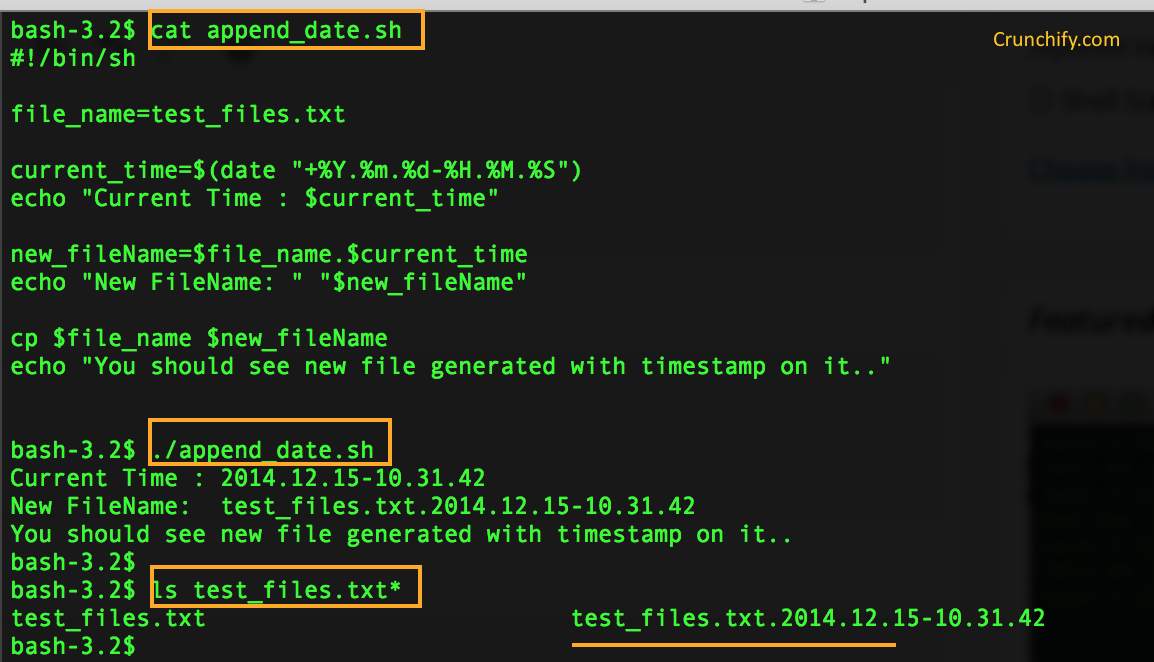
Append TimeStamp to file name

05/11/2023 Comments off

I need to create a shell script that appends a timestamp to existing file. I mainly use Mac OS X for development. Wanted to create the same on Mac Terminal.

Here are some basics on date command.

NAME

date -- display or set date and time

SYNOPSIS
date [-ju] [-r seconds] [-v [+|-]val[ymwdHMS]] ... [+output_fmt]
date [-jnu] [[[mm]dd]HH]MM[[cc]yy][.ss]
date [-jnu] -f input_fmt new_date [+output_fmt]
date [-d dst] [-t minutes_west]

Samples:

Script to append date stamp to file:

Categories: Système Tags: ,