Archive

Articles taggués ‘attacks’

HTTP DDoS Attack Mitigation Using Tarpitting

30/04/2024 Comments off

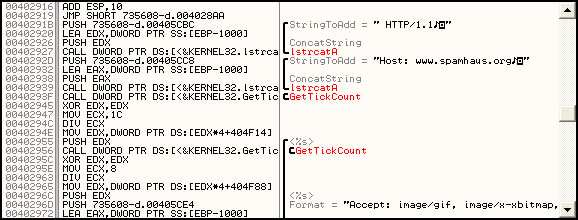
Recently, the anti-spam organization Spamhaus has come under yet another distributed denial-of-service attack. With some help from our good friends at myNetWatchman we were able to obtain a sample of the malware used in the attack. This one is particularly nasty, starting up 1500 threads to send randomized HTTP requests to Spamhaus’ webserver in a loop. This attack tool doesn’t have a command-and-control mechanism, so it was likely force-installed on all the infected systems of an existing botnet.

This kind of attack is particularly troublesome to deal with. While simplistic packet-based attacks can be more easily mitigated upstream, with an HTTP-based attack it is often difficult to distinguish attack traffic from legitimate HTTP requests. And because the attack consumes resources from the webserver, not just the system TCP/IP stack, it can quickly bring even a well-tuned webserver to its knees unless the target has better-than-average resources at its disposal to help weather the storm (like Spamhaus does).ddostool
Fortunately, most HTTP-based DoS attacks we have seen have a particular weakness – they are vulnerable to a technique known as « tarpitting ». This idea was first proposed by Tom Liston many years ago when the first scanning worms hit the Internet, and was implemented in his program LaBrea (which he no longer offers for download, due to legal concerns – however, the source code can still be found elsewhere and should work on Linux or BSD-based operating systems). The quickest way to implement tarpitting (if your webserver runs on Linux) is in the Linux netfilter source code. If the tarpit module is compiled for your Linux kernel, the operation becomes as simple as « iptables -A INPUT -s x.x.x.x -p tcp -j TARPIT« .

Tarpitting works by taking advantage of TCP/IP’s idea of window size and state. In a tarpitted session, we respond to the connection initiation as normal, but we immediately set our TCP window size to just a few bytes in size. By design, the connecting system’s TCP/IP stack must not send any more data than will fit in our TCP window before waiting for us to ACK the packets sent. This is to allow connections to deal with packet loss that might occur in a normal session. If the sending system doesn’t get an ACK to a packet sent, it will resend the packet at increasingly longer intervals. In our tarpitted session, we simply don’t ack any of the post-handshake packets at all, forcing the remote TCP/IP stack to keep trying to send us those same few bytes, but waiting longer each time. With this, bandwidth usage falls off quickly to almost nothing.

It might seem reasonable to simply use iptables -j DROP to not respond to connections at all – this will certainly prevent the webserver from seeing the connection, but because the connection may have a timeout set, it is likely we’ll keep seeing connection attempts at a fairly regular rate. Essentially a DROP rule turns our HTTP flood into a SYN flood.

Below is a chart made by running the Spamhaus DDoS malware on a single host in a sandnet, and comparing the bandwidth usage of each iptables mitigation technique with no mitigation. Here we extrapolated the bandwidth usage of the full non-mitigated attack (the blue line in the chart) from just the first 30 seconds of the attack, rather than let it fully DDoS the server the entire two hours. Under load, our untuned Apache server probably would have slowed down, forcing the attack bandwidth to decrease with it as it became unresponsive. In this simulation we are assuming the server can withstand a single attacker with no slowdown.ddosmitigation
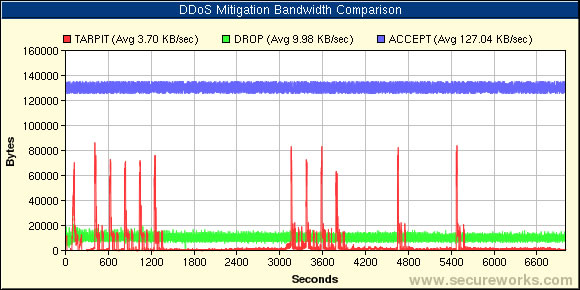
We see that although with tarpitting, there are momentary spikes as the sessions finally time out and try again, overall the average bandwidth usage is substantially lower with tarpitting as opposed to simply dropping the attacker’s packets.

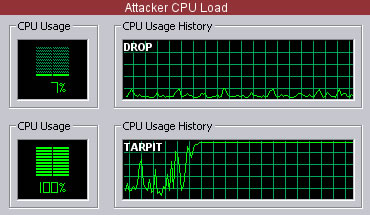
There seems to be an added side-effect to mitigation by tarpit. When the attacked host mitigates with an iptables DROP (no response), the attacker’s CPU load is fairly minimal and the system is responsive. However, as demonstated by the graphic below, under tarpitting the CPU load in our test system quickly rose to 100% as the attacking system’s kernel tried to maintain a large number of open connections in a retry state.

In the case of our test system, the user interface became nearly unresponsive. Of course, this may depend on the overal system CPU speed and RAM (our test was done in a VMware environment which also may be a factor), but if the system becomes unacceptibly slow, it serves as an impetus for the unknowing owner of the attacking system to have the computer cleaned of its botnet infection.cpuload
Unfortunately, the TARPIT iptables module is not part of every Linux distribution. It is possible to obtain it by getting the netfilter Patch-o-Matic-NG source and compiling it for your kernel (don’t forget the iptables source must also be patched to support the TARPIT option).

At some point, the scalability of having thousands of iptables rules may come into play. At the University of Florida, Chuck Logan and Jordan Wiens were able to successfully mitigate a DDoS attack from the Netsky virus by writing customized software to detect the attacking hosts and create intelligent chains of iptables rules that were more scalable. Details and source code can be found here.

No matter how you implement it, tarpitting isn’t going to completely stop an attack – it can only slow it down. However, it could be an effective stop-gap measure until upstream providers can effectively null-route an attack on your website, or until the attack stops on its own.

Source: Dell SecureWorks – Author: Joe Stewart

Denial-of-service Attack – DoS using hping3 with spoofed IP in Kali Linux

30/04/2024 Comments off

Source: blackmoreops.com

In computing, a denial-of-service (DoS) or distributed denial-of-service (DDoS) attack is an attempt to make a machine or network resource unavailable to its intended users. Although the means to carry out, the motives for, and targets of a DoS attack vary, it generally consists of efforts to temporarily or indefinitely interrupt or suspend services of a host connected to the Internet. In this article I will show how to carry out a Denial-of-service Attack or DoS using hping3 with spoofed IP in Kali Linux.Denial-of-service-Attack-–-DoS-using-hping3-with-spoofed-IP-in-Kali-Linux-blackMORE-Ops-51

As clarification, distributed denial-of-service attacks are sent by two or more persons, or bots, and denial-of-service attacks are sent by one person or system. As of 2014, the frequency of recognized DDoS attacks had reached an average rate of 28 per hour.

Perpetrators of DoS attacks typically target sites or services hosted on high-profile web servers such as banks, credit card payment gateways, and even root nameservers.

Denial-of-service threats are also common in business, and are sometimes responsible for website attacks.

This technique has now seen extensive use in certain games, used by server owners, or disgruntled competitors on games, such as popular Minecraft servers. Increasingly, DoS attacks have also been used as a form of resistance. Richard Stallman has stated that DoS is a form of ‘Internet Street Protests’. The term is generally used relating to computer networks, but is not limited to this field; for example, it is also used in reference to CPU resource management.

One common method of attack involves saturating the target machine with external communications requests, so much so that it cannot respond to legitimate traffic, or responds so slowly as to be rendered essentially unavailable. Such attacks usually lead to a server overload. In general terms, DoS attacks are implemented by either forcing the targeted computer(s) to reset, or consuming its resources so that it can no longer provide its intended service or obstructing the communication media between the intended users and the victim so that they can no longer communicate adequately.

Denial-of-service attacks are considered violations of the Internet Architecture Board’s Internet proper use policy, and also violate the acceptable use policies of virtually all Internet service providers. They also commonly constitute violations of the laws of individual nations.

hping3 works well if you have other DoS tools such as GoldenEye running (using multiple tools that attacks same site/server/service increases the chances of success). There are agencies and corporations to runs DoS attack map in Realtime. that shows worldwide DDoS attacks almost in realtime.

Lire la suite…

Block WordPress xmlprc.php DDOS attacks using Fail2Ban

17/04/2024 Comments off

Few days ago, my friend’s WordPress website went down. After investigation, I have figured out that it was receiving massive amount of posts requests to the xmlrpc.php file, which brings the apache and mysql to eat up all the system resources and the website crashed. Fortunately, I have figured out the way to mitigate this attack using Fail2Ban, which I’ll share in this post.

Install the Fail2Ban package using the following command:

apt-get install fail2ban iptables

1Make a local copy of jail.conf file for configuration change:

cp /etc/fail2ban/jail.conf /etc/fail2ban/jail.local

2

Lire la suite…

TCP SYN flood DOS attack with hping3

26/03/2024 Comments off

Hping

Wikipedia defines hping as :

hping is a free packet generator and analyzer for the TCP/IP protocol distributed by Salvatore Sanfilippo (also known as Antirez). Hping is one of the de facto tools for security auditing and testing of firewalls and networks, and was used to exploit the idle scan scanning technique (also invented by the hping author), and now implemented in the Nmap Security Scanner. The new version of hping, hping3, is scriptable using the Tcl language and implements an engine for string based, human readable description of TCP/IP packets, so that the programmer can write scripts related to low level TCP/IP packet manipulation and analysis in very short time.

On ubuntu hping can be installed from synaptic manager.

$ sudo apt-get install hping3

Syn flood

To send syn packets use the following command at terminal

$ sudo hping3 -i u1 -S -p 80 192.168.1.1

The above command would send TCP SYN packets to 192.168.1.1
sudo is necessary since the hping3 create raw packets for the task , for raw sockets/packets root privilege is necessary on Linux.

S – indicates SYN flag
p 80 – Target port 80
i u1 – Wait for 1 micro second between each packet

More options

Lire la suite…

MMD-0035-2015 – .IptabLex or .IptabLes on shellshock.. sponsored by ChinaZ actor

15/03/2024 Comments off

Source: Malware Must Die!

The background

.IptabLex & .IptabLes ELF DDoS malware is the malware made by China DDoSer crime group, designed to infect multiple architecture of Linux distribution, was aiming for Linux boxes in the internet with the low security and authentication flaw in SSH as vector of infection, was an emerged ELF threat in 2014.

Historically, MalwareMustDie, NPO (MMD) is the first entity who detected this malware around May last year and named it as Linux .Iptablesx|s on our last year’s alert MMD-0025-2014 [link] released on June 15, 2014. And we build malware repository for this ELF family for sharing samples and trend for researchers and industries on kernelmode started from September 4th 2014 [link], since the threat was gone so wild at the time and there was so few information about this malware that causing low awareness and detection ratio, so we managed all we can to suppress the growth of infection rate.

The DDoS attacks originated from this malware, in quantity of incidents and traffic used, was so massive in 2014 causing some warning was released from important security entities in September 2014, as per announced by Prolexic (thank you for mentioning MalwareMustDie) [link] in their Threat Advisory with « High Risk » level, following by Akamai‘s warning referred to the Prolexic’s advisory announcing the world wide warning [link] of .IptableS|X.

Afterward, Linux .IptableS / .IptablesX ELF malware was still be detected in the wild until the end of October 2014, but since November 2014 we did not find any significant wave of infection using these family, wiped by the emerge of many other China DDoS new malware families that we detected also afterwards. From the early this year (January 2015), we started to assume the malware popularity and development of .IptabLes|x was stopped..

However, on June 27th 2015 I was informed in the twitter by a friend @TinkerSec for what was suspected as Linux/ChinaZ infection. I supported him with ELF binary sample’s « real time » analysis in twitter as per shown in his report below:

Today, our team mate @benkow has detected a shellshock attack with having the same payload as sample, and curiousity made me taking a deeper analysis this time, to find and feel so surprised to realize that the payload is a Linux IptableS or .IptablesX variant actually. I can not believe this myself so I checked many times until I am very positive with this conclusion and after understanding why we were thinking it was Linux/ChinaZ I wrote this information as the follow up, the return of 2014’s DDoS disaster, the IptableS|X threat. Below is the detail.

Lire la suite…

Categories: Réseau, Sécurité Tags: , ,

