Linux Iptables To Block Different Attacks

09/05/2024 Categories: Réseau, Sécurité Tags: , , , , Comments off

Source: linoxide.com

Iptables is a Linux kernel based packet filter firewall. The iptables modules are present in the kernel itself, there is no separate daemon for it. This makes it very fast and effective firewall. The iptables rules control the incoming and outgoing traffic on a network device. In this article, we will discuss about some common network attacks, and how we can block them using iptables. Some of the common network attacks are SYN flood attack, smurf attack, land attack, attacks by malfunctioning ICMP packet, and some other forms of DOS attack. Before going into the details of these attacks, let’s have an overview of iptables, and how to use this command.

Iptables

iptables has 3 filtering points for the default table: INPUT, OUTPUT and FORWARD. These are called chains in iptables. As their names suggest, they specify whether a packets is destined for the system (INPUT), originating from it (OUTPUT) or is routed to another node in the network (FORWARD).
The rules in iptables are stored in the form of records in a table. To list the rules, run “iptables -L”

root@local:~# iptables -L
 Chain INPUT (policy ACCEPT)
 target prot opt source destination

 Chain FORWARD (policy ACCEPT)
 target prot opt source destination

 Chain OUTPUT (policy ACCEPT)
 target prot opt source destination

Here, no rules are present for any chain.These rules are read from top to bottom, and if a match occurs, no further rules are checked. So if one rule overwrites any previous rule, then it must be below that rule. So we will append the rules below existing rules. But if your requirement is to insert explicitly, then you can insert them as well.

To insert a rule (above all other rules or at a specified number), -i, and to append, -A option is used. We need to specify the chain, for which we wish to write the rule. The -j option specifies the target, i.e. what we want to do with the packet if a rule is matched. Some of the values are ACCEPT, DROP (or REJECT), RETURN etc. This target can be some other existing or user defined chain. But for the purpose of this article, we will confine ourselves to existing chains only, and will not go in further details.
Lire la suite…

What Is SYN Flood Attack? Detection & Prevention In Linux

09/05/2024 Categories: Réseau, Sécurité Tags: , , , , , Comments off

Source: linoxide.com

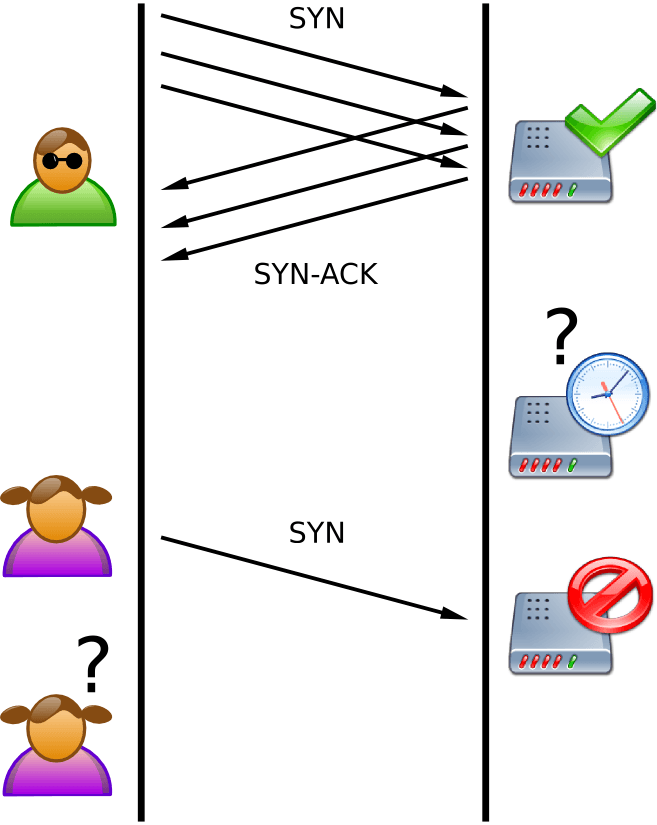
A SYN flood attack is a form of denial-of-service attack in which an attacker sends a large number of SYN requests to a target system’s services that uses TCP protocol. This will consume the server resources to make the system unresponsive to legitimate traffic. This attack can occur on any services that use TCP protocol and mainly on web service. In this article, we will go through the basics of SYN flood attacks and the mitigation steps in detail.

The SYN Flood attack exploits an implementation characteristic of the Transmission Control Protocol (TCP), which is called 3-way handshake. Following are the steps that happen in a normal 3-way handshake.

1. The client requests a connection by sending a SYN (synchronize) message to the server.
2. The server acknowledges this request by sending SYN-ACK back to the client.
3. The client responds with an ACK, and the connection is established

tcp_synflood

A SYN flood attack works by not responding to the server with the expected ACK code. By these half-open connections, the target machines TCP backlog will get filled up and hence all new connections may get ignored. This will cause the legitimate users will also get ignored.

Lire la suite…

How to Hide Application Port Using knockd in Linux

08/05/2024 Categories: Réseau, Sécurité Tags: , , Comments off

Source: linoxide.com

As a system administrator, we should do everything to secure our server from attackers. As the internet grows, threats to our server is also growing. One of the popular entrances to attack our server is through the port on your server that open. If your SSH server is running on your machine, then usually the SSH port is listening. Which means it is open, waiting for the connection.

Leaving the port open for 24 hours, is not recommended because it is vulnerable. Because we can scan the machine to see the open port. Nmap is one of the most popular port scanner that can be used by anyone to scan your machine.

Nmap

How if we can open the on demand and close the port when it’s not used? Sounds interesting. Now we can do it using knockd application.

What is knockd

Knockd is a port-knock server. It listens to all traffice on an ethernet (or PPP) interface, looking for special “knock” sequences of port-hits. (Source : http://www.zeroflux.org/projects/knock)

How it works

Every application needs a port as a “door” for “listening” requests from other clients. This port usually on open state or close state. There are a lot of ports that available on the server. But there are some ports that agreed by consensus, such as SSH (22), Web (80) and FTP (21).

A basic rule of server security is to open only used ports and close the rest. You may have some ports that are sometimes used and sometimes not. Leaving those ports open while is not being used is not recommended.

When you install knockd, you can let the client “knock” the server with pattern. The knocking sequence can be custom by you. So this knocking pattern will be unique to each other. If the pattern is match, then the port you need will be opened for a period of time and the request can enter your server.

Once you have done with the application, you can close the port manually or automatically.

Lire la suite…

Categories: Réseau, Sécurité Tags: , ,

Using iptables and watch command

08/05/2024 Categories: Réseau, Sécurité, Système Tags: , , , Comments off

Using iptables to list filtering rules is OK. Running this command in a shell loop can help but it needs that you write a shell script.

Another convenient way is to use the watch command:

watch --interval 0 'iptables -nvL'

or

sudo watch --interval 0 'iptables -nvL'

depending on whether you’re logged as super-user or not.

This will show a permanent iptables -L with a refresh interval that can be specified:

watch --interval 0 'iptables -nvL'

will refresh every second.

Typical output will be:

Every 10,0s: iptables -nvL                                                                                         Tue Nov  3 16:35:19 2015

Chain INPUT (policy DROP 44001 packets, 2444K bytes)
 pkts bytes target     prot opt in     out     source               destination
    3   160 fail2ban-ssh  tcp  --  *      *       0.0.0.0/0            0.0.0.0/0            multiport dports 22
  11M 1770M ACCEPT     all  --  *      *       0.0.0.0/0            0.0.0.0/0            state RELATED,ESTABLISHED
 107K 6878K ACCEPT     tcp  --  *      *       78.193.xx.xx         0.0.0.0/0
    0     0 ACCEPT     tcp  --  *      *       195.154.xx.xx        0.0.0.0/0
 231K   14M ACCEPT     tcp  --  *      *       213.36.xx.xx         0.0.0.0/0
    0     0 ACCEPT     tcp  --  *      *       195.154.xx.xx        0.0.0.0/0
    2    92 ACCEPT     tcp  --  *      *       0.0.0.0/0            0.0.0.0/0            tcp dpt:548
    0     0 ACCEPT     icmp --  *      *       0.0.0.0/0            0.0.0.0/0            icmptype 0
 1475  139K ACCEPT     icmp --  *      *       0.0.0.0/0            0.0.0.0/0            icmptype 8
  134  9600 ACCEPT     tcp  --  *      *       0.0.0.0/0            0.0.0.0/0            tcp spt:80
  110  6563 ACCEPT     tcp  --  *      *       0.0.0.0/0            0.0.0.0/0            tcp spt:443
    0     0 ACCEPT     tcp  --  *      *       0.0.0.0/0            0.0.0.0/0            tcp spt:943
 136K 9529K ACCEPT     udp  --  *      *       0.0.0.0/0            0.0.0.0/0            udp dpt:1194
 1423 85360 ACCEPT     tcp  --  *      *       0.0.0.0/0            0.0.0.0/0            tcp dpt:4949
    3   120 ACCEPT     tcp  --  eth0   *       0.0.0.0/0            0.0.0.0/0            tcp dpt:873 state NEW,ESTABLISHED
   24  1910 ACCEPT     udp  --  *      *       0.0.0.0/0            0.0.0.0/0            udp dpt:161
    0     0 ACCEPT     udp  --  *      *       0.0.0.0/0            0.0.0.0/0            udp dpt:162
    0     0 ACCEPT     udp  --  *      *       0.0.0.0/0            0.0.0.0/0            udp dpt:119
    2    92 ACCEPT     tcp  --  *      *       0.0.0.0/0            0.0.0.0/0            tcp dpt:3000
  156  7584 ACCEPT     tcp  --  *      *       0.0.0.0/0            0.0.0.0/0            tcp dpt:8080
 2952  177K ACCEPT     all  --  lo     *       0.0.0.0/0            0.0.0.0/0
    0     0 ACCEPT     tcp  --  *      *       172.27.xx.xx/24      0.0.0.0/0
    0     0 ACCEPT     tcp  --  as0t0  *       0.0.0.0/0            0.0.0.0/0
    3   192 ACCEPT     tcp  --  as0t1  *       0.0.0.0/0            0.0.0.0/0

Fun: Les insectes proliférateurs

07/05/2024 Categories: News Tags: 2 commentaires

Petit problème de maths, paru dans Le Monde il y a quelques années:

Coccinelle

Coccinelle

Une population d’insectes a un rythme de croissance effrayant: au 1er janvier 2004, elle comptait 2 004 individus. Au 2 janvier, ce nombre était de 4009 (le double plus un). Au 3 janvier, il était de 12028 (le triple du nombre précédent, plus un).

Chaque jour de janvier, la population se révèle être celle de la veille multipliée par le quantième du mois et augmentée de 1.

En février, le principe est le même, mais avec un accroissement de deux unités au lieu d’une ainsi la population du 1er février est celle du 31 janvier augmentée de deux, la population du 2 février équivaut au double de celle du 1er février plus deux, et ainsi de suite jusqu’au 29 février, où elle est égale à 29 fois celle du 28 février plus deux.

En mars, même principe, mais on ajoute 3, en avril on ajoute 4, etc. En décembre, on ajoute 12.

Ces insectes ont l’habitude de voler en formations de 13 individus.

Quand leur nombre n’est pas un multiple de 13, ils s’arrangent pour que le nombre d’insectes isolés soit le plus petit possible.

Combien d’insectes seront ils isolés au soir du 31 décembre 2004 ?

Categories: News Tags: