Archive

Archives pour la catégorie ‘Sécurité’

TCP SYN flood DOS attack with hping3

26/03/2024 Comments off

Hping

Wikipedia defines hping as :

hping is a free packet generator and analyzer for the TCP/IP protocol distributed by Salvatore Sanfilippo (also known as Antirez). Hping is one of the de facto tools for security auditing and testing of firewalls and networks, and was used to exploit the idle scan scanning technique (also invented by the hping author), and now implemented in the Nmap Security Scanner. The new version of hping, hping3, is scriptable using the Tcl language and implements an engine for string based, human readable description of TCP/IP packets, so that the programmer can write scripts related to low level TCP/IP packet manipulation and analysis in very short time.

On ubuntu hping can be installed from synaptic manager.

$ sudo apt-get install hping3

Syn flood

To send syn packets use the following command at terminal

$ sudo hping3 -i u1 -S -p 80 192.168.1.1

The above command would send TCP SYN packets to 192.168.1.1
sudo is necessary since the hping3 create raw packets for the task , for raw sockets/packets root privilege is necessary on Linux.

S – indicates SYN flag
p 80 – Target port 80
i u1 – Wait for 1 micro second between each packet

More options

Lire la suite…

Linux Iptables Avoid IP Spoofing And Bad Addresses Attacks

23/03/2024 Comments off

Source: nixCraft

Spoofing and bad address attack tries to fool the server and try to claim that packets had come from local address/network.

Following IP/netwok address are know to open this kind of attack:

Incoming source IP address is your servers IP address

Bad incoming address from following ranges:

  • 0.0.0.0/8
  • 127.0.0.0/8
  • 10.0.0.0/8
  • 172.16.0.0/12
  • 192.168.0.0/16
  • 192.168.0.0/16
  • 224.0.0.0/3
  • Your own internal server/network ip address/ranges.

Lire la suite…

How to: Linux Iptables block common attacks

23/03/2024 Comments off

Source: nixCraft

Following list summaries the common attack on any type of Linux computer:

Syn-flood protection

In this attack system is floods with a series of SYN packets. Each packets causes system to issue a SYN-ACK responses. Then system waits for ACK that follows the SYN+ACK (3 way handshake). Since attack never sends back ACK again entire system resources get fulled aka backlog queue. Once the queue is full system will ignored incoming request from legitimate users for services (http/mail etc). Hence it is necessary to stop this attack with iptables.

Force SYN packets check

Make sure NEW incoming tcp connections are SYN packets; otherwise we need to drop them:

iptables -A INPUT -p tcp ! --syn -m state --state NEW -j DROP

Force Fragments packets check

Packets with incoming fragments drop them. This attack result into Linux server panic such data loss.

iptables -A INPUT -f -j DROP

XMAS packets

Incoming malformed XMAS packets drop them:

iptables -A INPUT -p tcp --tcp-flags ALL ALL -j DROP

Lire la suite…

Categories: Sécurité, Système Tags: ,

Linux Iptables Limit the number of incoming tcp connection / syn-flood attacks

22/03/2024 Comments off

A SYN flood is a form of denial-of-service attack in which an attacker sends a succession of SYN requests to a target’s system. This is a well known type of attack and is generally not effective against modern networks. It works if a server allocates resources after receiving a SYN, but before it has received the ACK.

if Half-open connections bind resources on the server, it may be possible to take up all these resources by flooding the server with SYN messages. Syn flood is common attack and it can be block with following iptables rules:

iptables -A INPUT -p tcp –syn -m limit –limit 1/s –limit-burst 3 -j RETURN

All incoming connection are allowed till limit is reached:

  • –limit 1/s: Maximum average matching rate in seconds
  • –limit-burst 3: Maximum initial number of packets to match

Open our iptables script, add the rules as follows:

# Limit the number of incoming tcp connections
# Interface 0 incoming syn-flood protection
iptables -N syn_flood
iptables -A INPUT -p tcp --syn -j syn_flood
iptables -A syn_flood -m limit --limit 1/s --limit-burst 3 -j RETURN
iptables -A syn_flood -j DROP
#Limiting the incoming icmp ping request:
iptables -A INPUT -p icmp -m limit --limit  1/s --limit-burst 1 -j ACCEPT
iptables -A INPUT -p icmp -m limit --limit 1/s --limit-burst 1 -j LOG --log-prefix PING-DROP:
iptables -A INPUT -p icmp -j DROP
iptables -A OUTPUT -p icmp -j ACCEPT

First rule will accept ping connections to 1 per second, with an initial burst of 1. If this level crossed it will log the packet with PING-DROP in /var/log/message file. Third rule will drop packet if it tries to cross this limit. Fourth and final rule will allow you to use the continue established ping request of existing connection.
Where,

  • ‐‐limit rate: Maximum average matching rate: specified as a number, with an optional ‘/second’, ‘/minute’, ‘/hour’, or ‘/day’ suffix; the default is 3/hour.
  • ‐‐limit‐burst number: Maximum initial number of packets to match: this number gets recharged by one every time the limit specified above is not reached, up to this number; the default is 5.

You need to adjust the –limit-rate and –limit-burst according to your network traffic and requirements.

Let us assume that you need to limit incoming connection to ssh server (port 22) no more than 10 connections in a 10 minute:

iptables -I INPUT -p tcp -s 0/0 -d $SERVER_IP --sport 513:65535 --dport 22 -m state --state NEW,ESTABLISHED -m recent --set -j ACCEPT
iptables -I INPUT -p tcp --dport 22 -m state --state NEW -m recent --update --seconds 600 --hitcount 11 -j DROP
iptables -A OUTPUT -p tcp -s $SERVER_IP -d 0/0 --sport 22 --dport 513:65535 -m state --state ESTABLISHED -j ACCEPT
Categories: Réseau, Sécurité Tags: , ,

Réalisez un audit sécurité de votre système GNU/Linux facilement

19/03/2024 Comments off

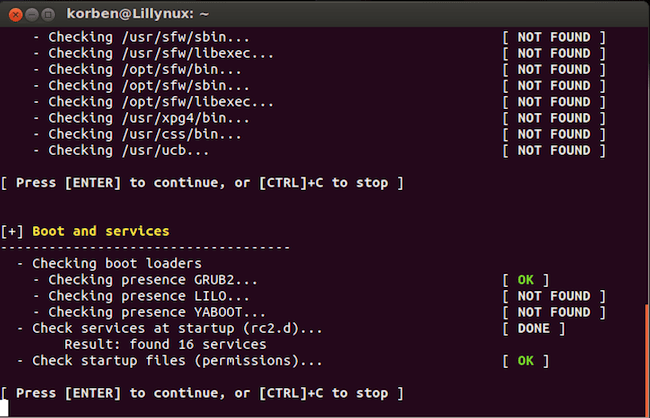
audit securiteDéveloppé par la même personne derrière le scanner de malware Rkhunter, Lynis est un outil qui va vous permettre de réaliser un audit simple de votre machine sous GNU/Linux.

Pour installer Lynis (sous Ubuntu) :

sudo apt-get install lynis

Pour lancer le scan :

sudo lynis -clynis1


Ensuite, l’analyse se fera sur les utilitaires systèmes, le bootloader et les services, le kernel, la mémoire et les processus, tout ce qui est utilisateurs, groupes et authentification, les shells, le système de fichiers, le stockage, NFS, DNS, les ports et les packages, la config réseau, les imprimantes, les logiciels de messagerie, le firewall, le serveur web, la config SSH, SNMP, les bases de données, LDAP, PHP, Squid, les logs, les services non sécurisés, la crontab, les comptes, l’heure et la synchronisation temporelle, le chiffrement, la virtualisation, les frameworks de sécurité présents, les softs de vérification d’intégrité des fichiers, les scanners de malware, les utilitaires systèmes, les répertoires home…etc.

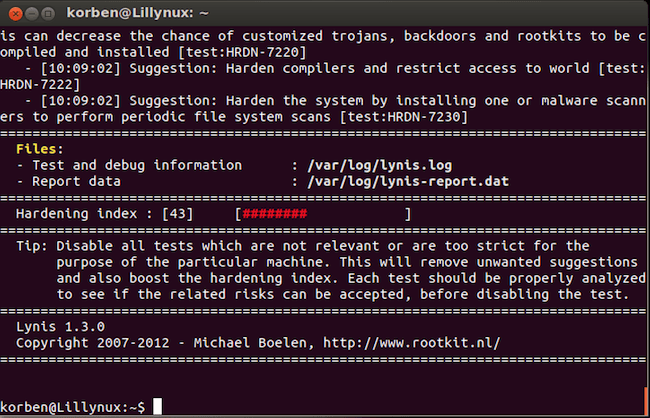
Le scan se termine ensuite par une liste de suggestions plus ou moins longue de petites choses à améliorer pour rendre votre système plus sécurisé.lynis21


Pour info, le rapport complet, une fois achevé se trouve ici : /var/log/lynis.log

Par exemple, pour visualiser uniquement les choses qui urgent (Warning), il suffit de faire un petit grep :

sudo grep Warning /var/log/lynis.log

Et pour consulter uniquement les bons conseils de Lynis :

sudo grep Suggestion /var/log/lynis.log

De quoi, déjà, faire un bon petit tour d’horizon sur les faiblesses de votre système et ne rien laisser grand ouvert qu’un méchant hacker pourrait exploiter.

Source: korben.info