Le « Alternative PHP Cache » (APC) est un cache d’opcode libre et ouvert pour PHP permetant d’optimiser le code PHP et le cache de données et le code compilé PHP depuis le compilateur bytecode en mémoire partagée. Il a été conçu afin de fournir un framework libre, ouvert et robuste pour la mise en cache et l’optimisation de code intermédiaire PHP. (extension PECL, incluse en standard à partir de PHP6)
eAccelerator est né en Décembre 2004 comme une branche de Turck MMCache projet. Turck MMCache a été créé par Dmitry Stogov et une grande partie de la eAccelerator code est toujours fondée sur son travail. eAccelerator contenait également un codeur PHP et chargeur, mais le développement personnel de l’encodeur abandonnées et ont supprimé cette fonction après Décembre 2006. Lire la suite…
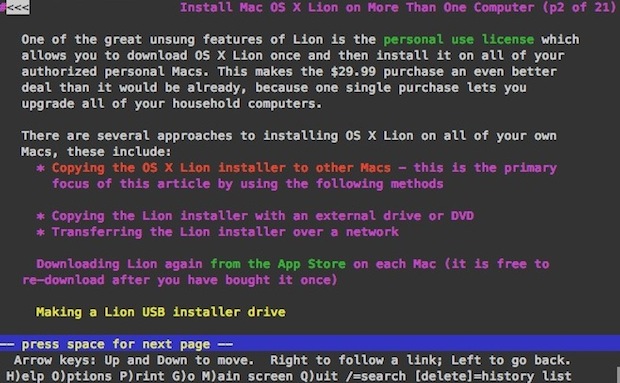
Lynx is a text based command line web browser, it’s relatively popular within unix communities but it also has a variety of general uses too; it’s great if you want to discretely browse the web and read articles at work or school, and developers use lynx frequently to test accessibility and to roughly estimate how spiders or crawlers view a website. Because it only loads text and avoids javascript and images, it’s also lightning fast.
Anyway, after updating to Lion I discovered my previous installation of lynx was not functioning. Thankfully it’s very easy to install a working version with the help of MacPorts.
Installing and Running Lynx in Mac OS X 10.7 Lion
For the purpose of this walkthrough, we’re going to keep requirements to a minimum and install lynx through MacPorts, here’s what you’ll need:
Assuming you have now installed Xcode 4.1 and MacPorts 2.0, here’s how to install lynx:
sudo port install lynx
MacPorts will then fetch all the required dependencies including ncurses and zlib, and then proceed to install the lynx browser.
Once it’s finished, just type ‘lynx’ at the command line and it’ll launch as expected. You can then hit “G” to go to a URL, or open one directly from the command line.
This opens OSXDaily.com, for example:
lynx osxdaily.com
You then just use the arrow keys and return/enter to navigate around a site.
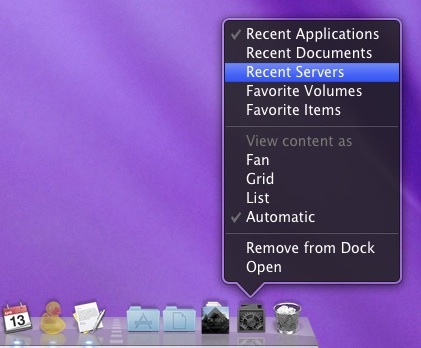
You can add a Recent Items menu to the Mac OS X Dock by using a defaults write command. The default is set to “Recent Applications” but once the Dock item exists you can adjust it to feature other recent items too.
That needs to all be on a single line, so if you copy and paste it make sure the command is one string.
You will then need to kill the Dock:
killall Dock
Now right-click on the newly appeared Recent Applications Dock item and you can change it to be Recent Applications, Recent Documents, Recent Servers, Favorite Volumes, or Favorite Items.
If you want to remove the Recent Items menu, just drag it out of your Dock.
If you lost your ISPConfig 3 administrator password, you can reset it with the following SQL query.
UPDATE sys_user SET passwort = md5(‘admin’) WHERE username = ‘admin’;
The SQL query sets the password to “admin” for the user “admin”, it has to be executed in the ISPConfig mysql database, e.g. with phpmyadmin. If you dont have phpmyadmin installed, then the query can be executed with the mysql commandline utility as well:
Login to the mysql database.
mysql -u root -p
and enter the password of the mysql root user. To switch to the ISPConfig database, run this command:
use dbispconfig;
Now execute the SQL command:
UPDATE sys_user SET passwort = md5(‘admin’) WHERE username = ‘admin’;
Lorsque vous utilisez Webmin pour administrer votre serveur, les paramètres de votre firewall iptables sont visibles et manageables depuis la console Webmin.
Toutefois, les règles iptables présentées par Webmin sont celles qui ont été préalablement sauvées par /sbin/iptables-save dans le fichier que vous avez choisi.
Donc si vous utilisez un script depuis le shell pour changer les règles de iptables, ce ne seront pas ces règles que Webmin vous présentera mais celles que vous avez sauvées préalablement avec Webmin.When using Webmin as an administration tool, iptables rules visible for Webmin are those previously saved through Webmin.
So when you use a shell script to change iptables rules on the fly, these rules won’t be the ones Webmin present to you.