Archive

Articles taggués ‘shell’

Forcer logrotate à créer une nouvelle version d’un fichier de log

11/01/2024 Comments off

Récemment, je me suis aperçu que mon dernier fichier /var/log/auth.log n’avait pas été renouvelé depuis le 17/04/2011… Evidemment, ça n’aide pas à analyser sereinement les fichiers de logs, vu la taille que ça génère: 105306586 c’est-à-dire plus de 100Mo !

Je voulais conserver 26 semaines de logs pour analyser les tentatives d’intrusion et calculer leur évolution au fur et à mesure que je renforçais la protection de mon serveur.

Tout simple:

  • créer un fichier séparé pour auth.log qu’on appelle /etc/logrotate.d/auth:

/var/log/auth.log

{
        rotate 26
        weekly
        missingok
        notifempty
        compress
        delaycompress
        sharedscripts
        postrotate
                reload rsyslog >/dev/null 2>&1 || true
        endscript
}

  • retirer la référence à /var/log/auth.log dans /etc/logrotate.d/auth
  • redémarrer le service rsyslog:
/etc/init.d/rsyslog restart

Lire la suite…

Aria2 – L’outil de téléchargement ultra rapide

10/01/2024 Comments off

Source: korben.info

Les barbus du Linux le connaissent depuis longtemps, mais pour les autres, je vous explique rapidement. Tout d’abord Aria2 est sous licence GPL et tourne sans aucun souci sous Mac, Linux, Windows et même Android. L’outil est léger (il consomme peu de CPU et de mémoire), mais surtout très puissant puisqu’il gère en plus des liens classiques, les Metalink, ce qui lui permet de télécharger des fichiers en exploitant plusieurs connexions simultanées utilisant plusieurs sources et/ou protocoles différents.

Oui c’est fou ! Cela permet d’exploiter au maximum la bande passante que vous avez à votre disposition.

Aria2 supporte donc le HTTP, FTP, mais aussi Bittorrent avec toutes ses fonctionnalités (DHT, chiffrement PEX, URI magnétique, Web-Seeding, téléchargement sélectif, tracker UDP et le protocole Local Peer Discovery). Aria2 est aussi pilotable à distance (support RPC) et gère sans souci ce qui est droit d’accès, cookies, proxys…etc.

N’allez pas croire que Aria2 est un outil compliqué à prendre en main. Taratata, c’est au contraire très simple à piger, comme vous allez voir dans les exemples ci-dessous :

Pour télécharger simplement un fichier :

aria2c http://example.org/mylinux.iso

Pour télécharger un fichier à partir de 2 sources différentes (HTTP, FTP) :

aria2c http://a/f.iso ftp://b/f.iso

Pour télécharger un fichier à partir de 3 connexions de source différente (Torrent, FTP, HTTP) :

aria2c -Ttest.torrent "http://host1/file" "ftp://host2/file"

Si ça vous branche d’explorer un peu plus ses possibilités, la documentation est ici. Autrement, sachez aussi qu’il existe des interfaces graphiques pour Aria2 comme :

  • webui-aria2: Interface navigateur
  • uGet: Gestionnaire de téléchargement Linux

Aria2 est téléchargeable ici.

Categories: Réseau, Système Tags: , ,

Fixing Mac OSX File Permissions and ACLs From the Command Line

09/01/2024 Comments off

Recently the hard drive in my mac mini running Mac OSX Leopard (10.5) failed. Luckily I had time machine backing it up to an external USB disk. Now, since I had to replace the drive and rebuild my system anyway I figured, why not upgrade to Snow Leopard? Planning to just pull what I needed off the backup drive manually I went ahead with the upgrade. There aren’t too many files on this machine that I depend on. Just some ssh keys, gpg keys and random documents scattered about here and there. So I upgraded, installed my apps and copied my files from the backup. Everything was going smoothly until I tried to actually write to one of the files I copied from the backup drive. This is when I started getting permission errors.

Here’s what happened when I tried to update my ssh known_hosts file:

airbag:~ keith$ echo foo > .ssh/known_hosts 
-bash: .ssh/known_hosts: Permission denied

Huh? But I own this file…dont I?

airbag:~ keith$ id
uid=501(keith) gid=20(staff) groups=20(staff),402(com.apple.sharepoint.group.1),204(_developer),100(_lpoperator),98(_lpadmin),81(_appserveradm),80(admin),79(_appserverusr),61(localaccounts),12(everyone),401(com.apple.access_screensharing)

airbag:~ keith$ ls -al .ssh/known_hosts 
-rw-r--r--@ 1 keith 502 56140 Mar 25 2009 .ssh/known_hosts
I do own it… And so began much head scratching and man page reading.

Well, as it turns out I forgot to look at the file ACLs…

airbag:~ keith$ ls -le .ssh/known_hosts 
-rw-r--r--@ 1 keith 502 56140 Mar 25 2009 .ssh/known_hosts
 0: group:everyone deny write,delete,append,writeattr,writeextattr,chown

Well no wonder, the ACL is set to deny write,delete,append,writeattr,writeextattr and chown from everyone! Let’s get rid of that.

airbag:~ keith$ sudo chmod -N .ssh/known_hosts 
Password:

That ought to do it. The -N flag says get rid of all the ACL info on the file. You could also update this to be just right for your user or group but I’d rather use only the standard unix permissions.

airbag:~ keith$ ls -le .ssh/known_hosts 
-rw-r--r--@ 1 keith 502 56140 Mar 25 2009 .ssh/known_hosts

Seems to have removed all ACLs from the file. I wonder if we can write to it now…

airbag:~ keith$ echo foo >> .ssh/known_hosts 
airbag:~ keith$

And there you have it, the file is writable once again. Now its time to get some real work done!

Categories: Système Tags: , , , ,

How to list the crontabs for all users?

09/01/2024 Comments off

I ended up writing a script (I’m trying to teach myself the finer points of bash scripting, so that’s why you don’t see something like Perl here). It’s not exactly a simple affair, but it does most of what I need. It uses Kyle’s suggestion for looking up individual users’ crontabs, but also deals with /etc/crontab(including the scripts launched by run-parts in /etc/cron.hourly, /etc/cron.daily, etc.) and the jobs in the /etc/cron.d directory.source: How do I list all cron jobs for all users?

I ended up writing a script (I’m trying to teach myself the finer points of bash scripting, so that’s why you don’t see something like Perl here). It’s not exactly a simple affair, but it does most of what I need. It uses Kyle’s suggestion for looking up individual users’ crontabs, but also deals with /etc/crontab(including the scripts launched by run-parts in /etc/cron.hourly, /etc/cron.daily, etc.) and the jobs in the /etc/cron.d directory.

It takes all of those and merges them into a display something like the following:

#!/bin/bash
# System-wide crontab file and cron job directory. Change these for your system.
 CRONTAB='/etc/crontab'
 CRONDIR='/etc/cron.d'
# Single tab character. Annoyingly necessary.
 tab=$(echo -en "\t")
# Given a stream of crontab lines, exclude non-cron job lines, replace
 # whitespace characters with a single space, and remove any spaces from the
 # beginning of each line.
 function clean_cron_lines() {
 while read line ; do
 echo "${line}" |
 egrep --invert-match '^($|\s*#|\s*[[:alnum:]_]+=)' |
 sed --regexp-extended "s/\s+/ /g" |
 sed --regexp-extended "s/^ //"
 done;
 }
# Given a stream of cleaned crontab lines, echo any that don't include the
 # run-parts command, and for those that do, show each job file in the run-parts
 # directory as if it were scheduled explicitly.
 function lookup_run_parts() {
 while read line ; do
 match=$(echo "${line}" | egrep -o 'run-parts (-{1,2}\S+ )*\S+')
if [[ -z "${match}" ]] ; then
 echo "${line}"
 else
 cron_fields=$(echo "${line}" | cut -f1-6 -d' ')
 cron_job_dir=$(echo "${match}" | awk '{print $NF}')
if [[ -d "${cron_job_dir}" ]] ; then
 for cron_job_file in "${cron_job_dir}"/* ; do # */
 [[ -f "${cron_job_file}" ]] && echo "${cron_fields} ${cron_job_file}"
 done
 fi
 fi
 done;
 }
# Temporary file for crontab lines.
 temp=$(mktemp) || exit 1
# Add all of the jobs from the system-wide crontab file.
 cat "${CRONTAB}" | clean_cron_lines | lookup_run_parts >"${temp}"
# Add all of the jobs from the system-wide cron directory.
 cat "${CRONDIR}"/* | clean_cron_lines >>"${temp}" # */
# Add each user's crontab (if it exists). Insert the user's name between the
 # five time fields and the command.
 while read user ; do
 crontab -l -u "${user}" 2>/dev/null |
 clean_cron_lines |
 sed --regexp-extended "s/^((\S+ +){5})(.+)$/\1${user} \3/" >>"${temp}"
done <
# Output the collected crontab lines. Replace the single spaces between the
 # fields with tab characters, sort the lines by hour and minute, insert the
 # header line, and format the results as a table.
 cat "${temp}" |
 sed --regexp-extended "s/^(\S+) +(\S+) +(\S+) +(\S+) +(\S+) +(\S+) +(.*)$/\1\t\2\t\3\t\4\t\5\t\6\t\7/" |
 sort --numeric-sort --field-separator="${tab}" --key=2,1 |
 sed "1i\mi\th\td\tm\tw\tuser\tcommand" |
 column -s"${tab}" -t
rm --force "${temp}"

source: How do I list all cron jobs for all users?

Change & Set the Default crontab Editor

08/01/2024 Comments off


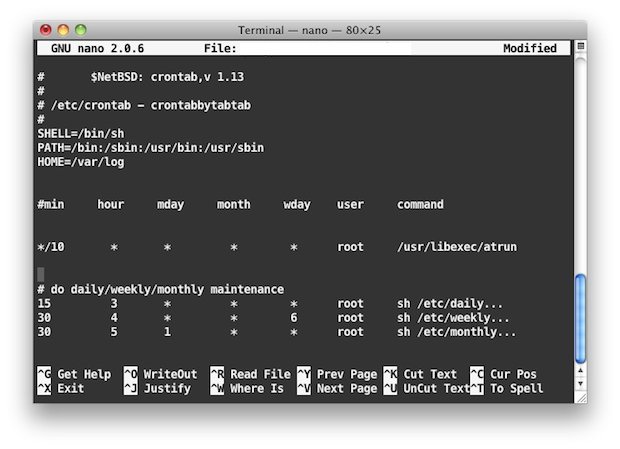
Most hardcore command line users and unix geeks love vi, but I prefer nano. If you want to change your default crontab editor to nano, here’s how to do this:

For a one time edit, launch the terminal and type:

EDITOR=nano crontab -e

If you want to set nano as your default editor in general, you use this command:

export EDITOR=nano

Now when you go to edit crontab, nano will be the default editor than vi. You can test this by typing:

crontab -e

Looking beyond Mac OS X, this should work in Linux as well.

Categories: Système Tags: , , , ,