Anyone who has administered even a moderately high traffic server will have noticed that certain unwelcome traffic such as port scans and probes tend to come from IP addresses belonging to a certain group of countries. If your application or service does not cater to users in these countries, it might be a safe bet to block these countries off entirely.
This is especially true for email servers. The average email server, based on anecdotal evidence of servers for around 20 domains, rejects about 30% of incoming email every day as spam. Some servers on some days reject up to as much as 97% of incoming email as spam. Most of these originate in a certain subset of countries. That is a lot of wasted CPU cycles being expended on scanning these undesired emails for spam and viruses. Although tools such as amavisd and spamassasin do a good job of keeping the vast majority of spam out of users’ inboxes, when the rare well crafted and targeted phishing email does get through, it wrecks havoc in the enterprise.
Though Mac users don’t usually have to worry excessively about “camfecting” malware and spyware, some security conscious users may find it nice to know if a process or application is attempting to access their computers web camera or microphone.
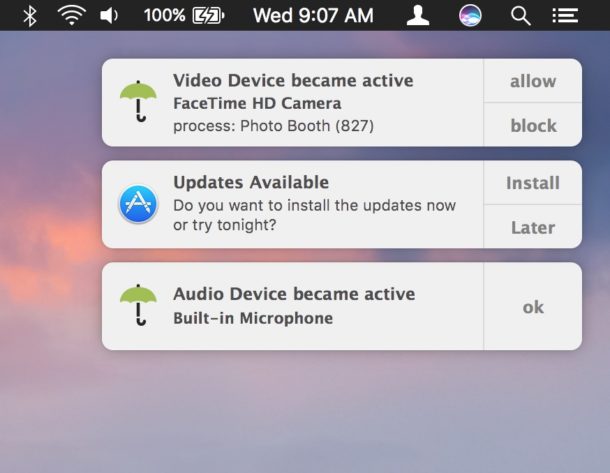
With the help of a free third party security utility called Oversight, you can have your Mac alert you anytime an application or process tries to activate either recording device on the computer.
The developer of Oversight explains why a tool like Oversight could be valuable to some users:
“One of the most insidious actions of malware, is abusing the audio and video capabilities of an infected host to record an unknowing user. Macs, of course, are not immune; malware such as OSX/Eleanor, OSX/Crisis, OSX/Mokes, and others, all attempt to spy on OS X users. OverSight constantly monitors a system, alerting a user whenever the internal microphone is activated, or the built-in webcam is accessed. And yes, while the webcam’s LED will turn on whenever a session is initially started, new research has shown that malware can surreptitious piggyback into such existing sessions (FaceTime, Sykpe, Google Hangouts, etc.) and record both audio and video – without fear of detection.”
Sound good? If so, it’s a free download that is easy to install on a Mac with either macOS or Mac OS X:
If you’re interested in this app, simply download Oversight and run the installer (it can be just as easily uninstalled later if you decide you do not need it).
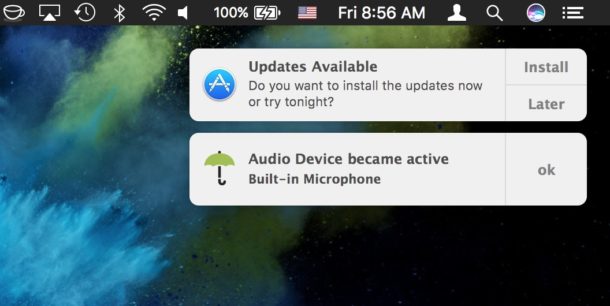
Once installed, Oversight is small and lightweight running quietly in the background, and it will alert you anytime the Mac microphone or webcam FaceTime camera are attempting to be activated. You can then directly intervene and either allow the webcam or microphone access (for legitimate use), or deny it (for theoretical illegitimate use).
Keep in mind that Oversight does not differentiate between legitimate and illegitimate use of the webcam and microphone on your Mac, that is up to you. For example, you will get a notification alert that the microphone and FaceTime camera are trying to be accessed when you open an app like Skype, Photo Booth, FaceTime, or are recording a video on your Mac with the webcam, but since those applications legitimately use the computers microphone and camera they are probably nothing to be concerned about (assuming you have launched them yourself anyway). On the other hand, if out of the blue and with no provocation if you see a process has attempted to access your microphone, that could potentially be an unauthorized attempt to use the microphone and you could choose to reject it and block the device access with Oversight. Whenever possible, Oversight will attempt to notify you of the process name and PID, but sometimes you will see blank notifications of access anyway – again just think about what apps you are using and if they have any reason to use your camera or microphone, similar to how you can control this type of access in iOS for Photos, camera, and microphone.
This is a software solution which is quite a bit more fancy than the low-tech solution of putting tape on your web camera like the FBI Director does and many security professionals do. You could always use Oversight along with some tape too if you’re extra concerned about your Mac webcam or microphone access and want to be sure nothing fishy is going on from camfecting or otherwise.
While apps like Oversight could be considered overboard and unnecessary for many Mac users, others who are privacy conscious or in fields where higher security matters may find them to be helpful. I’ve personally noticed a particular web browser will occasionally attempt to access the microphone on my Mac from time to time without an obvious reason which I find to be… curious… and Oversight notified me each time. It’s not for everyone, but if you want to be notified when something is trying to use your Mac camera or microphone, check out the app yourself.
MySQL fait partie des systèmes de gestion de bases de données les plus utilisés du monde, que ça soit par le grand public ou par les professionnels. De nombreuses entreprises comme Google, Facebook, Yahoo, YouTube, Adobe, l’utilisent encore pour gagner du temps et faire tourner leurs larges sites web, malgré l’émergence et la montée en puissance de nouvelles solutions, notamment les systèmes de gestion de bases de données NoSQL. MySQL est également plébiscité par les petites entreprises en raison de son prix d’implantation nettement inférieur, qui fait de ce système une solution simple et peu onéreuse à mettre en œuvre pour des applications non critiques.
Le chercheur de sécurité polonais Dawid Golunsku a dévoilé deux vulnérabilités dans MySQL, compromettant la sécurité des serveurs. Le chercheur a détaillé l’une des failles de sécurité et a décrit sa méthode d’exploitation. Oracle n’a toujours pas corrigé les deux vulnérabilités, malgré le fait qu’elles ont été signalées il y a plus de quarante jours.
La première vulnérabilité affecte « tous les serveurs MySQL en configuration par défaut dans toutes les versions de MySQL (5.7, 5.6 et 5.5), dont les dernières versions ». Les variantes liées à MySQL, MariaDB et PerconaDB, n’ont pas été épargnées par cette vulnérabilité, néanmoins, des correctifs leur ont été appliqués.
« Une exploitation réussie [de la vulnérabilité CVE-2016-6662] permettrait à un attaquant d’exécuter du code arbitraire avec les privilèges root, ce qui lui permettrait de compromettre entièrement le serveur », explique le chercheur. La faille CVE-2016-6662 peut être exploitée si un hacker a accès à une connexion authentifiée à une base de données MySQL (à travers une connexion réseau ou une interface web comme phpMyAdmin) ou une injection SQL, même avec les modules SELinux et AppArmor installés. Les attaquants peuvent injecter des réglages malicieux dans les fichiers de configuration MySQL, my.cnf, le but étant d’acquérir l’accès root et d’exécuter un code malicieux additionnel. Cette vulnérabilité fait surface 13 ans après qu’un correctif avait été déployé pour remédier à un problème similaire.
Le chercheur a révélé également l’existence d’une seconde faille, néanmoins il n’est pas entré en détail sur la méthode de son exploitation. « Il est à noter que des attaquants peuvent utiliser l’une des autres failles découvertes par l’auteur de ce bulletin, auquel a été assigné l’identifiant CVE CVE-2016-6663 et est en attente de publication. Cette faille facilite la création d’un fichier /var/lib/mysql/my.cnf au contenu arbitraire, sans besoin du privilège FILE ».
Oracle n’a toujours pas adressé officiellement ces vulnérabilités, même si un correctif de sécurité a été publié il y a quelques jours, afin de limiter le risque. Il parait qu’Oracle a secrètement corrigé quelques bogues révélés par Golunski, en limitant les emplacements valides pour charger une bibliothèque au démarrage du service incriminé et en empêchant la génération des fichiers de configuration .ini ou .cnf par la base de données. Même avec ce correctif (MySQL 5.6.33, 5.7.15 et 5.5.52 ?) , le risque reste élevé, surtout avec la persistance d’une deuxième faille non encore détaillée. Si Golunski a révélé l’existence de la vulnérabilité après un mois et demi, avec un prototype limité, c’est pour mettre en garde les utilisateurs afin qu’ils puissent se protéger.
Il faut rappeler que des forks de MySQL, comme par exemple MariaDB et PerconaDB, ont été aussi notifiés de l’existence de la vulnérabilité, et ont déjà pu déployer des correctifs pour corriger les deux failles.
The OTPW package consists of the one-time-password generator otpw-gen plus two verification routinesotpw_prepare() and otpw_verify() that can easily be added to programs such as login or ftpd on POSIX systems. For platforms that support the Pluggable Authentication Method (PAM) interface, a suitable wrapper is included as well. Login software extended this way will allow reasonably secure user authentication over insecure network lines. The user carries a password list on paper. The scheme is designed to be robust against theft of the paper list and race-for-the-last-letter attacks. Cryptographic hash values of the one-time passwords are stored for verification, either in the user’s home directory or in a dedicated system directory.
Introduction
A well-known classic vulnerability of the Internet application protocol suite is the frequent cleartext transfer of passwords in the telnet, rsh, and ftp protocols. Modern replacements for these protocols such as Tatu Ylönen’sSecure Shell allow comfortable and secure remote sessions and file transfers over network connection that are not trusted to provide confidentiality.
However, traveling computer users often want to connect to their home system via untrusted terminals at conference hotels, other universities, and airports, where trusted encryption software is not available. Even Secure Shell does not protect against keyboard eavesdropping software on the untrusted terminal. A loss of confidentiality is often acceptable in these situations for the session content, but not for reusable login passwords. One-time-password schemes avoid the transmission of authentication secrets that are of any value after they have been used. This provides a reasonable level of protection against the widely encountered password sniffing attacks. The goal of a one-time-password login scheme is merely to provide a significant increase of security over the classic telnet/rlogin login procedure. It does not aim to protect from sophisticated active attacks such as session hijacking, host emulation, man-in-the-middle, etc. against which ssh and SSL based protocols should be used if this level of protection is required.
A widely known one-time-password scheme is S/KEY [Hal94, HM96]. OTPW is not compatible with and is not derived from either S/KEY or OPIE. It is a completely independent and different design, which I believe fulfils my functional and security requirements better.
How it works
One-time password authentication with the OTPW package is accomplished via a file containing hash values of passwords. Depending on the installation option chosen, this can either be a file ~john/.otpw located in the user’s home directory, or it can be a file ~otpw/john in the home directory of a dedicated pseudo user “otpw”. In the latter case, the otpw-gen tool for generating new passwords must be owned by pseudo user “otpw” and have the SETUID bit set. As long as users do not have such a hash file, the one-time-password facility is not active for them.
A user who wants to setup the one-time-password capability just executes the otpw-gen program. The program will ask for a prefix password that the user has to select and memorize and it will then write to standard output a password list such as:
Normally the output of otpw-gen should be sent directly to the printer as in
otpw-gen | lpr
or should be first formatted with an ASCII to PostScript converter where necessary.
Fetch the printed list immediately from the printer, fold it, and keep it with you. The list shows the machine name and the creation time to allow users to find the latest list for the right machine. It does not show the user’s name, because nobody is supposed to have the list of anyone else, but printer drivers such as a2ps might add it. Only a single list is required for a set of networked machines on which the user has a common home directory.
By default, otpw-gen generates 60 lines of output. Use the command line options -hlines, -wcolumns, and -spages to specify the length of the output. No more than 1000 passwords will be generated at a time.
Where one-time-password authentication is used, the password prompt will be followed by a 3-digit password number. Enter first the prefix password that was given to otpw-gen, followed directly (without hitting return between) by the password with the requested number from the printed password list:
  login: kuhn
  Password 019: geHeimOdAkH62c
In this example, geHeim was the prefix password. The spaces in the password list are just there to increase readability and can be dropped.
A clever attacker might observe the password being entered and might try to use the fact that computers can send data much faster than users can finish entering passwords. In the several hundred milliseconds that the user needs to press the return key after the last character, an attacker could on a parallel connection to the same machine send the code of the return key faster than the user.
To prevent such a race-for-the-last-key attack, any login attempt that is taking place concurrently with another attempt will require three one-time passwords to be entered:
This might look inconvenient at first, but remember that three passwords will only be requested when someone tries to login simultaneously, which in itself should already cause suspicion. The three requested passwords are randomly selected but they will never include the single password that was requested in the first of the concurrent login attempts. Only the first requested single password will be locked, not any of the requested triples. This way, the three-password method ensures that an attacker cannot disable the OTPW mechanism by locking all passwords. The triple challenge ensures that many ten thousand network connections would be necessary to perform a race attack on the same password triple, which is not practical. The OTPW package creates a symbolic link .otpw.lock in the user’s home directory to lock the first requested password while its input is pending. If a system crash created a stale lock, it will be removed after 24 hours.