Archive

Articles taggués ‘firewall’

Communication Networks/IP Tables

28/05/2024 Comments off

Operational summary

The netfilter framework, of which iptables is a part of, allows the system administrator to define rules for how to deal with network packets. Rules are grouped into chains—each chain is an ordered list of rules. Chains are grouped into tables—each table is associated with a different kind of packet processing.

Each rule contains a specification of which packets match it and a target that specifies what to do with the packet if it is matched by that rule. Every network packet arriving at or leaving from the computer traverses at least one chain, and each rule on that chain attempts to match the packet. If the rule matches the packet, the traversal stops, and the rule’s target dictates what to do with the packet. If a packet reaches the end of a predefined chain without being matched by any rule on the chain, the chain’s policy target dictates what to do with the packet. If a packet reaches the end of a user-defined chain without being matched by any rule on the chain or the user-defined chain is empty, traversal continues on the calling chain (implicit target RETURN). Only predefined chains have policies.

Rules in iptables are grouped into chains. A chain is a set of rules for IP packets, determining what to do with them. Each rule can possibly dump the packet out of the chain (short-circuit), and further chains are not considered. A chain may contain a link to another chain – if either the packet passes through that entire chain or matches a RETURN target rule it will continue in the first chain. There is no limit to how many nested chains there can be. There are three basic chains (INPUT, OUTPUT, and FORWARD), and the user can create as many as desired. A rule can merely be a pointer to a chain.

Tables

There are three built-in tables, each of which contains some predefined chains. It is possible for extension modules to create new tables. The administrator can create and delete user-defined chains within any table. Initially, all chains are empty and have a policy target that allows all packets to pass without being blocked or altered in any fashion.

  • filter table — This table is responsible for filtering (blocking or permitting a packet to proceed). Every packet passes through the filter table. It contains the following predefined chains, and any packet will pass through one of them:
    • INPUT chain — All packets destined for this system go through this chain (hence sometimes referred to as LOCAL_INPUT)
    • OUTPUT chain — All packets created by this system go through this chain (aka. LOCAL_OUTPUT)
    • FORWARD chain — All packets merely passing through the system (being routed) go through this chain.
  • nat table — This table is responsible for setting up the rules for rewriting packet addresses or ports. The first packet in any connection passes through this table: any verdicts here determine how all packets in that connection will be rewritten. It contains the following predefined chains:
    • PREROUTING chain — Incoming packets pass through this chain before the local routing table is consulted, primarily for DNAT (destination-NAT).
    • POSTROUTING chain — Outgoing packets pass through this chain after the routing decision has been made, primarily for SNAT (source-NAT).
    • OUTPUT chain — Allows limited DNAT on locally-generated packets
  • mangle table — This table is responsible for adjusting packet options, such as quality of service. All packets pass through this table. Because it is designed for advanced effects, it contains all the possible predefined chains:
    • PREROUTING chain — All packets entering the system in any way, before routing decides whether the packet is to be forwarded (FORWARD chain) or is destined locally (INPUT chain).
    • INPUT chain — All packets destined for this system go through this chain
    • FORWARD chain — All packets merely passing through the system go through this chain.
    • OUTPUT chain — All packets created by this system go through this chain
    • POSTROUTING chain — All packets leaving the system go through this chain.

In addition to the built-in chains, the user can create any number of user-defined chains within each table, which allows them to group rules logically.

Each chain contains a list of rules. When a packet is sent to a chain, it is compared against each rule in the chain in order. The rule specifies what properties the packet must have for the rule to match, such as the port number or IP address. If the rule does not match then processing continues with the next rule. If, however, the rule does match the packet, then the rule’s target instructions are followed (and further processing of the chain is usually aborted). Some packet properties can only be examined in certain chains (for example, the outgoing network interface is not valid in the INPUT chain). Some targets can only be used in certain chains, and/or certain tables (for example, the SNAT target can only be used in the POSTROUTING chain of the nat table).
Lire la suite…

Simple Stateful Load Balancer with iptables and NAT

27/05/2024 Comments off

To demonstrate how iptables can perform network address translation this how-to shows how to use it to implement a over-simplified load balancer. In practice we would use a daemon such as HAProxy allowing IP tables to check packets before forwarding them.

Using the method presented in this tutorial packets get forwarded without going through the INPUT, FORWARD and OUTPUT chains.

iptables is a powerful tool that is used to create rules for how incoming or outgoing packets are handled. It keeps track of a packets state – there is NEW, ESTABLISHED, RELATED, INVALID and UNTRACKED. It can make filtering decisions based on the packets header data and the payload section of the packet, for these purposes iptables even has regular expression matching.

On top of that iptables has extensions that can be used to filter packets based on a packets history so we can keep track of packets and sessions. We can set filters to only trigger at specific times, parse the packet contents and header information searching for specific patterns, differentiate protocols such as tcp, udp, icmp, etc.

For load balancing behavior we want the incoming packets on one machine to be routed to another machine. iptables has extentions that helps us achieve this aim but we also need to muck around with its internal PREROUTING and POSTROUTING table, which is not recommended as this could potentially pose a security risk. lets use iptables to route all traffic coming in on an interface eth0 with a destination port 80 and route it to another IP address:

Allow IP forwarding

(Note: if your testing this on the same box your doing this on it won’t work, you need at least 3 machines to test this out, virtual ones work nicely)

First we enable ipv4 forwarding or this will not work:
# echo "1" > /proc/sys/net/ipv4/ip_forward

XOR

# sysctl net.ipv4.ip_forward=1

next we add a filter that changes the packets destination ip and allows us to masquerade:

# iptables -t nat -A PREROUTING -i eth0 -p tcp --dport 80 -j DNAT --to-destination 10.0.0.3:80
# iptables -t nat -A POSTROUTING -j MASQUERADE

The above filter gets added to iptables PREROUTING chain. The packets first go through the filters in the PREROUTING chain before iptables decides where they go. The above filter says all packets input into eth0 that use tcp protocol and have a destination port 80 will have their destination address changed to 1.2.3.4 port 80. The DNAT target in this case is responsible for changing the packets Destination IP address. Variations of this might include mapping to a different port on the same machine or perhaps to another interface all together, that is how one could implement a simple stateful vlan (in theory).

The masquerade option acts as a one to many NAT server allowing one machine to route traffic with one centralized point of access. This is similar to how many commercial firewalls and network routers function.

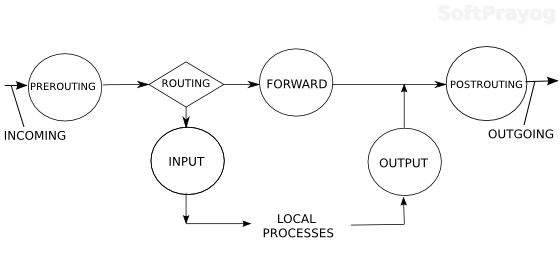
The above ruleset results in all incoming packets to dport 80 traversing the iptables chains in a straight line from INCOMING to OUTGOING in the image below, effectively bypassing any rules we might have had in our INPUT chain. If we were to choose to implement nat like this we would need to implement those – our desired INPUT filter rules – on the machines where traffic is forwarded OR add them to the FORWARD chain if we want to block things before they are forwarded (Note: packets might go through FORWARD chain in both directions so direction needs to be considered when writing filters for this chain).

560x260xbuilt-in-chains-in-filter-table.png.pagespeed.ic.CVAYVeFJ96

Path incoming packets take through iptables chains

Lire la suite…

Layer 7 DDOS – Blocking HTTP Flood Attacks

26/05/2024 Comments off

There are many types of Distributed Denial of Service (DDOS) attacks that can affect and bring down a website, and they vary in complexity and size. The most well known attacks are the good old SYN-flood, followed by the Layer 3/4 UDP and DNS amplification attacks.

Today though, we’re going to spend a little time looking at Layer 7, or what we call an HTTP Flood Attack.

An HTTP flood attack is a type of Layer 7 application attack that utilizes the standard valid GET/POST requests used to fetch information, as in typical URL data retrievals (images, information, etc.) during SSL sessions. An HTTP GET/POST flood is a volumetric attack that does not use malformed packets, spoofing or reflection techniques. – DDoSAttacks.biz

If you’re wondering, yes, we deal with these every day, and we protect our client websites via our Website Firewall.

Today I’m going to share with you some details on a rather large DDoS attack that leveraged the following HTTP request flood attack to wreak havoc on a clients website. I’ll also share the steps we took to mitigate the issue.

Layer 7 DDoS – HTTP Flood Attacks

The first thing to understand about Layer 7 attacks is that they require more understanding about the website and how it operates. The attacker has to do some homework and create a specially crafted attack to achieve their goal. Because of this, these types of DDoS attacks require less bandwidth to take the site down and are harder to detect and block.

Layer 7 DDoS – Part 1: Random URLs

This specific client came to us after his site was down for almost a week. They tried other services to protect their website with not much luck. As soon as he switched his DNS to us, we gained a much deeper appreciation and started to see why.

He was getting thousands of requests like these every second:

75.118.29.205 - - [20/Jan/2014:19:32:06 -0500] "GET /?458739416183768700 HTTP/1.1" 200 440 "http://movies.netflix.com/WiPlayer?movieid=70136122&trkid=7882978&t=Weeds" ""
173.245.56.201 - - [20/Jan/2014:19:32:06 -0500] "GET /?458726993617499500 HTTP/1.1" 200 440 "http://landing.pcwhatsap.com/1/?offer_id=3534&aff=1788&url_id=5618&sub_id=whatsapp_pop" ""
79.19.41.22 - - [20/Jan/2014:19:32:06 -0500] "GET /?458741338856272200 HTTP/1.1" 200 440 "http://www.rumoreweb.it/index.php?option=com_news_portal&view=category&id=21&Itemid=259" ""
190.121.64.3 - - [20/Jan/2014:19:32:06 -0500] "GET /?458722169268652700 HTTP/1.1" 200 440 "http://www.eldivisadero.cl/noticias/?task=show&id=37352" ""
186.54.141.146 - - [20/Jan/2014:19:32:06 -0500] "GET /?458741274224646000 HTTP/1.1" 200 440 "http://badoo.com/01244944965/?r=37.4&p=1" ""

To be more exact, he was getting 5,233 HTTP requests every single second. From different IP addresses around the world.

What is important to note here is how this worked against the client’s platform. The client’s website was built on WordPress. The uniqueness of the requests were bypassing the caching system, forcing the system to render and respond to every request. This was bringing about system failures as the server quickly became overwhelmed by the requests.

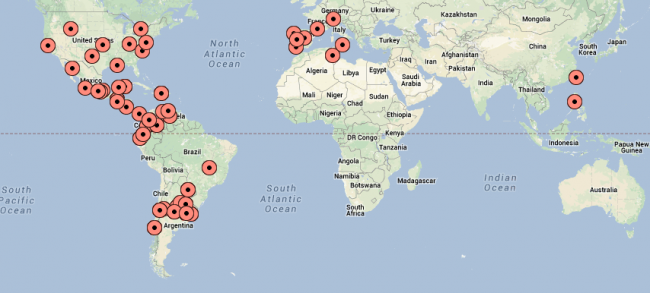
For illustration purposes, here is a quick geographic distribution of the IP’s hitting the site. This is for 1 second in the attack. Yes, every second these IP’s were changing.

Stopping the DDoS: Once we identified the type of attack, blocking was easy enough. By default, they were not passing our anomaly check, causing the requests to get blocked at the firewall. One of the many anomalies we look for are valid user agents, and if you look carefully you see that the requests didn’t have one. Hopefully, you’ll also noticed that the referrers were dynamic and the packets were the same size, another very interesting signature. Needless to say, this triggered one of our rules, and within minutes his site was back and the attack blocked.

Lire la suite…

Trafic monitor small solution for Linux

22/05/2024 Comments off

Source: Trafic monitor small solution for Linux

TRAFIPgraph

The software is really small and fast to install. Was designed to work mostly with iptables and on Linux platform.

Installation is easy. Just add those lines to your firewall or put somewhere to start allways.
After this modification the collect.sh script with the result from your iptables -L -n. And of course put the .php files somewhere to access via www and make the directory writeable. The output file must be in the directory where are the php files. By default without selecting anything will show last hour traffic. It’s pretty live(update at 6 seconds, not like other programs).

Quick example:

[root@lair trafip]# iptables -A OUTPUT -s 0.0.0.0/0 -d 127.0.0.1
[root@lair trafip]# iptables -A INPUT -d 0.0.0.0/0 -s 127.0.0.1
[root@lair trafip]# iptables -L -n|grep 127|grep -v ACCEPT|grep -v LOG|grep -v DROP
all -- 127.0.0.1 0.0.0.0/0
all -- 0.0.0.0/0 127.0.0.1

Get the strings « 127.0.0.1 0.0.0.0/0 » and « 0.0.0.0/0 127.0.0.1 » and put in collect.sh. Must be exact like iptables shows (better you copy paste that part). The script collect.sh must be always running to count.

In img.php modify:

$target variable with the name where you redirect the output from collect.sh (ex: $target="local";)
$ip variable with the IP (ex: $ip="127.0.0.1";)
$maxspeed variable with the maximum traffic can be done in 6 seconds (ex: $ip="115200";). If you have black lines on your graph without stopping the interface/traffic then increase the value.
$upload variable with red or green (ex: $upload="red";)
$download variable with red or green (ex: $download="green";)
$imagetype variable with png, gif or jpg, if for output format of graph (ex: $imagetype="gif")

The output file must be something like:

11/12/02 05:57:26 10782702 149477806
11/12/02 05:57:32 10783170 149489806
11/12/02 05:57:38 10783810 149509426

(format: month/day/year[space]hour:minutte:second[space]INPUT_counter[space]OUTPUT_counter

Bandwidth monitoring with iptables

22/05/2024 Comments off

Source: By Gerard Beekmans

Linux has a number of useful bandwidth monitoring and management programs. A quick search on Freshmeat.net for bandwidth returns a number of applications. However, if all you need is a basic overview of your total bandwidth usage, iptables is all you really need — and it’s already installed if you’re using a Linux distribution based on the 2.4.x or 2.6.x kernels.

Most of the time we use iptables to set up a firewall on a machine, but iptables also provides packet and byte counters. Every time an iptables rule is matched by incoming or outgoing data streams, the software tracks the number of packets and the amount of data that passes through the rules.

It is easy to make use of this feature and create a number of « pass-through rules » in the firewall. These rules do not block or reroute any data, but rather keep track of the amount of data passing through the machine. By using this feature, we can build a simple, effective bandwidth monitoring system that does not require additional software.

Depending on how the firewall rules are set up, the setup for bandwidth monitoring may be very simple or very complex. For a desktop computer, you may need to create only two rules to log the total input and output. A system acting as a router could be set up with additional rules to show the totals for one or more subnets, right down to the individual IP address within each subnet. In addition to knowing exactly how much bandwidth each host and subnet on the network is using, this system could be used for billing or chargeback purposes as well.

Rules setup

The rules setup itself is quick and straightforward, and takes only a few minutes. Obviously, you need to be root or use sudo to insert iptables rules.

The examples in this article are based on a router that provides Internet service to various towns. The iptables rules keep track of how much bandwidth each town uses and how much bandwidth each customer in that town uses. At the end of each month, an administrator checks the counters. Individuals who use more than they were supposed to get billed for over usage, the counters are reset to zero, and the process is repeated at the beginning of the next month.

The IP addresses in this article are modified from the real addresses. We’ll use the private IP space 192.168.0.0/16, subnetted into smaller blocks.

First, we will create two custom chains for the two towns and put town-specific rules in them. This will keep the built-in FORWARD chain relatively clean and easy to read. In this example, the FORWARD chain will only provide the global counters (all customers combined on a per-town basis).

iptables -N town-a
 iptables -N town-b

The next data element is the total bandwidth counter. Because this machine is a router only, the INPUT and OUTPUT chains are of little interest. This machine will not be generating a significant amount of bandwidth (i.e., it is not serving as a mail or Web server), nor will it be receiving significant uploads from other hosts.

Total bandwidth downloaded by and uploaded to the two towns combined:

iptables -A FORWARD

This is the easiest of rules. The rule will match any source and any destination. Everything that is being passed through this router matches this rule and will provide the total of combined downloaded and uploaded data.

Lire la suite…
