Archive

Articles taggués ‘administration’

How to list the crontabs for all users?

09/01/2024 Comments off

I ended up writing a script (I’m trying to teach myself the finer points of bash scripting, so that’s why you don’t see something like Perl here). It’s not exactly a simple affair, but it does most of what I need. It uses Kyle’s suggestion for looking up individual users’ crontabs, but also deals with /etc/crontab(including the scripts launched by run-parts in /etc/cron.hourly, /etc/cron.daily, etc.) and the jobs in the /etc/cron.d directory.source: How do I list all cron jobs for all users?

I ended up writing a script (I’m trying to teach myself the finer points of bash scripting, so that’s why you don’t see something like Perl here). It’s not exactly a simple affair, but it does most of what I need. It uses Kyle’s suggestion for looking up individual users’ crontabs, but also deals with /etc/crontab(including the scripts launched by run-parts in /etc/cron.hourly, /etc/cron.daily, etc.) and the jobs in the /etc/cron.d directory.

It takes all of those and merges them into a display something like the following:

#!/bin/bash
# System-wide crontab file and cron job directory. Change these for your system.
 CRONTAB='/etc/crontab'
 CRONDIR='/etc/cron.d'
# Single tab character. Annoyingly necessary.
 tab=$(echo -en "\t")
# Given a stream of crontab lines, exclude non-cron job lines, replace
 # whitespace characters with a single space, and remove any spaces from the
 # beginning of each line.
 function clean_cron_lines() {
 while read line ; do
 echo "${line}" |
 egrep --invert-match '^($|\s*#|\s*[[:alnum:]_]+=)' |
 sed --regexp-extended "s/\s+/ /g" |
 sed --regexp-extended "s/^ //"
 done;
 }
# Given a stream of cleaned crontab lines, echo any that don't include the
 # run-parts command, and for those that do, show each job file in the run-parts
 # directory as if it were scheduled explicitly.
 function lookup_run_parts() {
 while read line ; do
 match=$(echo "${line}" | egrep -o 'run-parts (-{1,2}\S+ )*\S+')
if [[ -z "${match}" ]] ; then
 echo "${line}"
 else
 cron_fields=$(echo "${line}" | cut -f1-6 -d' ')
 cron_job_dir=$(echo "${match}" | awk '{print $NF}')
if [[ -d "${cron_job_dir}" ]] ; then
 for cron_job_file in "${cron_job_dir}"/* ; do # */
 [[ -f "${cron_job_file}" ]] && echo "${cron_fields} ${cron_job_file}"
 done
 fi
 fi
 done;
 }
# Temporary file for crontab lines.
 temp=$(mktemp) || exit 1
# Add all of the jobs from the system-wide crontab file.
 cat "${CRONTAB}" | clean_cron_lines | lookup_run_parts >"${temp}"
# Add all of the jobs from the system-wide cron directory.
 cat "${CRONDIR}"/* | clean_cron_lines >>"${temp}" # */
# Add each user's crontab (if it exists). Insert the user's name between the
 # five time fields and the command.
 while read user ; do
 crontab -l -u "${user}" 2>/dev/null |
 clean_cron_lines |
 sed --regexp-extended "s/^((\S+ +){5})(.+)$/\1${user} \3/" >>"${temp}"
done <
# Output the collected crontab lines. Replace the single spaces between the
 # fields with tab characters, sort the lines by hour and minute, insert the
 # header line, and format the results as a table.
 cat "${temp}" |
 sed --regexp-extended "s/^(\S+) +(\S+) +(\S+) +(\S+) +(\S+) +(\S+) +(.*)$/\1\t\2\t\3\t\4\t\5\t\6\t\7/" |
 sort --numeric-sort --field-separator="${tab}" --key=2,1 |
 sed "1i\mi\th\td\tm\tw\tuser\tcommand" |
 column -s"${tab}" -t
rm --force "${temp}"
source: How do I list all cron jobs for all users?

Astuce pour « ssh-copy-id » sur un port ssh différent

06/01/2024 Comments off

Bon, a priori vous connaissez la commande "ssh-copy-id" pour copier sa clé publique sur un serveur distant afin de s’identifier par clé et plus par mot de passe.

Le principe est d’avoir une paire de clés privée/publique, le plus souvent dans "~/.ssh/id_rsa(.pub)" et de la copier à l’intérieur du fichier "~/.ssh/authorized_keys" sur la machine distante.

$ ssh-copy-id -i ~/.ssh/id_rsa.pub user@host

Mais si la machine distante n’accepte pas les connexions sur le port 22 ou bien qu’il y a une redirection de ports sur le routeur, il faut lui indiquer ce port, par exemple :

$ ssh-copy-id -i ~/.ssh/id_rsa.pub -p 2222 user@host

Mais ça ne marche pas car ssh-copy-id ne comprend que 2 paramètres et si on met "-p 2222" en second, ça n’est pas un motif de type "[user@]host", et si on le met après, en troisième, il est ignoré.

Et bien il suffit d’entourer les infos de connexion ssh par des guillemets pour qu’ils soient vus comme un seul paramètre :

$ ssh-copy-id -i ~/.ssh/id_rsa.pub "-p 2222 user@host"


Source: Jérémy Lecour

Dupliquer un système Debian / Ubuntu

02/01/2024 Comments off

Dupliquer un système consiste à installer, sur une machine, exactement les mêmes paquets que sur une autre. La technique n’a rien de nouveau en soi, mais il est toujours bon de la rappeler. Sous les dérivés de Debian, “dpkg” permet d’effectuer cette opération rapidement.

Sur la machine à dupliquer, exporter la liste des paquets installés :

# dpkg --get-selections > lstpkg.dpkg

Sur la machine à installer, commencez par poser un système minimal (installation via le CD-Rom “businesscard” sans sélectionner aucun groupe de paquets). Copiez la liste des paquets exportée depuis la machine à dupliquer et importez la dans le gestionnaire de paquets local :

# dpkg --set-selections < lstpkg.dpkg

puis lancez l’installation des paquets ainsi sélectionnés :

# apt-get dselect-upgrade

Note 1 : si vous souhaitez des machines réellement identique, commencez par copier “/etc/passwd” et “/etc/group” de la machine à dupliquer sur la machine cible afin que les programmes installés utilisent les mêmes UIDs et GIDs (exemple : bind, apache, etc…).

Note 2 : Lors de la sauvegarde des configurations de serveurs, conserver un export de la liste des paquets installés sur chacun d’eux peut faire gagner beaucoup de temps en cas de problème…

Source: admin-linux.fr

Top 32 Nmap Command Examples For Sys/Network Admins

22/12/2023 Comments off

The purpose of this post is to introduce a user to the nmap command line tool to scan a host and/or network, so to find out the possible vulnerable points in the hosts. You will also learn how to use Nmap for offensive and defensive purposes.

nmap in actionnmap in action

More about nmap

From the man page:

Nmap (“Network Mapper”) is an open source tool for network exploration and security auditing. It was designed to rapidly scan large networks, although it works fine against single hosts. Nmap uses raw IP packets in novel ways to determine what hosts are available on the network, what services (application name and version) those hosts are offering, what operating systems (and OS versions) they are running, what type of packet filters/firewalls are in use, and dozens of other characteristics. While Nmap is commonly used for security audits, many systems and network administrators find it useful for routine tasks such as network inventory, managing service upgrade schedules, and monitoring host or service uptime.

It was originally written by Gordon Lyon and it can answer the following questions easily:

  1. What computers did you find running on the local network?
  2. What IP addresses did you find running on the local network?
  3. What is the operating system of your target machine?
  4. Find out what ports are open on the machine that you just scanned?
  5. Find out if the system is infected with malware or virus.
  6. Search for unauthorized servers or network service on your network.
  7. Find and remove computers which don’t meet the organization’s minimum level of security.

Lire la suite…

Categories: Réseau, Système Tags:

Track Multiple Files Simultaneously With MultiTail

25/11/2023 Comments off

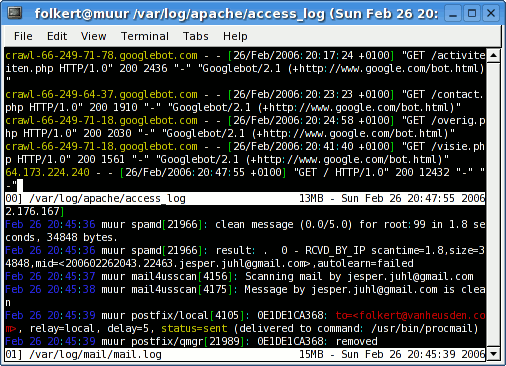
https://www.dbsysnet.com/wp-content/uploads/2016/06/multitail-gnome-terminal.pngThe tail utility is one of the most useful tools an admin has — but it’s also a bit limited and dated. For watching two or more logs at once, and much more, you want MultiTail.

The tail utility is one of the most useful admin tools, but it’s limited and outdated. Bring your log-watching capabilities into the 21st century and view multiple logs at one time with MultiTail.

What’s MultiTail? It’s an ncurses utility that can display multiple files using « windows » (much like GNU Screen or Tmux) in a terminal or at the console. It also supports color highlighting, filtering and much more.

To get MultiTail, head over to the download page or see if your operating system already has packages. On Debian-based systems, you should need to look for only the multitail package. The project released an update (5.2.8) on April 14, so the most recent release probably won’t be in your upstream package repo just yet.

Once it’s installed, run multitail and hit F1. It will pop up a help menu with all of its keybindings. You’ll need to scroll down (use the down arrow key) to see all of the commands. It can be deceptive, otherwise, and it looks like you just have a few commands. Let’s look at a couple of the commands you’ll want to start with.

First, run t — this displays the stats for your instance of MultiTail. To add files, use the a command.

If you want to start multitail with a file or output of a command to access, use multitailfilename or multitail filename1 filename2 for more than one file. Use multitail -R 3 -l "command" -R 3 -l "command2" to see two commands displayed in one window.

Using the h command within MultiTail, you can set the height of each window. If you want to search through a window, use / or shift / to highlight the search string. Using I will toggle case sensitivity.

When you’ve used the search feature, you’ll get a buffer that displays in a « window » above the file. You can write this to a file using s, which will bring up a dialog that prompts for a filename to which to save.

If you get a MultiTail session configured just right you can save it for later using w from within the session. It will prompt you for a filename to which to save the script.

Basically, you can do just about anything you’d be able to do with tail and then some. It’s very interactive, and much of its commands have dialogs that will walk you through creating regular expressions or re-arranging windows and more.

The only caveat I have is that, occasionally, MultiTail is a bit crashy. Not wholly unreliable, but I have managed to crash MultiTail a few times while putting it through its paces. (I’ve never managed to crashtail…). But it’s still an invaluable tool to have around for any Linux or UNIX admin.

Joe ‘Zonker’ Brockmeier is a freelance writer and editor with more than 10 years covering IT. Formerly the openSUSE Community Manager for Novell, Brockmeier has written for Linux Magazine, Sys Admin, Linux Pro Magazine, IBM developerWorks, Linux.com, CIO.com, Linux Weekly News, ZDNet, and many other publications. You can reach Zonker at [email protected] and follow him on Twitter.

Source: ServerWatch

Categories: Système Tags: , ,