WordPress Performance Tuning

23/05/2024 Categories: Logiciel Tags: , Comments off

wordpress performance tuning
WordPress is one of the most popular content publishing platform used by some of the very high traffic website. Beauty of the wordpress is in its simplicity. If you will setup your WordPress correctly then your website performance will be fantastic. In this article we will explore various aspect of the WordPress Performance Tuning. Before going further let me clear that why you need to optimize your WordPress website performance.

Why you should spend time on WordPress Performance Tuning ?

Performance tuning or Optimization is required due to following reason:

  1. If you will correctly optimize or tune your WordPress performance then your visitor experience will be better.
  2. Search engines are giving high preference to high speed website.  So your SEO will be improved.
  3. Sometime while doing your WordPress performance tuning you will analyzed and remove unwanted thing from your WordPress which reduce your server work. So your server will have less load.

Tool / Plugin / Stuff you need while WordPress Performance tuning

WordPress performance tuning does not mean to only changing some configuration of your WordPress. There are several area where you need to fine tune like apache(your webserver), Mysql etc. So before going further you need following tool/plugin

  1. Installation of plugin w3 total plugin.
  2. Firefox web browser with firebug tool.
  3. Google Page Speed Test  or GT Metrix.
  4. SSH connection to your server (only required if you want to tune Apache and MySQL performance).
  5. A good Internet speed.

Before going further for your WordPress Performance Tuning please arrange above written tool.

Analyze your WordPress Performance

Before going to optimize your WordPress Performance you need to analyze that whether your website performance is good or bad. Or in other word we can say that you need to check whether your website is served quickly or not. Following are the factor which mainly affect your website performance and you need to check.

  1. Time taken to load your web page
  2. Number of CSS, js and Images are getting downloaded on every request
  3. CSS and JS are placed correctly or not.

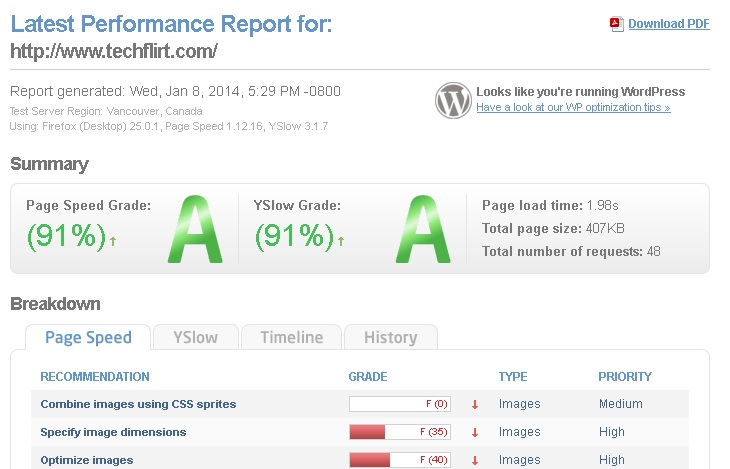
You can check your website performance in either Google Page Speed or Gtmetrix. I prefer to use Gtmetrix. Both tool will gives rating to your website Speed and suggestion to improve your website performance further. Gtmetrix will also provide you the timeline waterfall(what is repose time of your website and how many images, css , js or other resources are getting downloaded) of your website. I prefer Gtmetrix because of TimeLine waterfall feature.
You will get following type snapshot for your website in Gtmetrix
WordPress Performance Tuning

In above snapshot you can see the following 4 tab

  1. Page Speed : In this tab you can find your website performance analysis with GooglePageSpeed.
  2. YSlow : In this tab you can find your website performance analysis with YSlow.
  3. TimeLine : In this tab you can find your website page load water fall.
  4. History: In this tab you can find previous history of your website page speed test if you did the test in in future.

Lire la suite…

Categories: Logiciel Tags: ,

Trafic monitor small solution for Linux

22/05/2024 Categories: Réseau, Sécurité Tags: , , Comments off

Source: Trafic monitor small solution for Linux

TRAFIPgraph

The software is really small and fast to install. Was designed to work mostly with iptables and on Linux platform.

Installation is easy. Just add those lines to your firewall or put somewhere to start allways.
After this modification the collect.sh script with the result from your iptables -L -n. And of course put the .php files somewhere to access via www and make the directory writeable. The output file must be in the directory where are the php files. By default without selecting anything will show last hour traffic. It’s pretty live(update at 6 seconds, not like other programs).

Quick example:

[root@lair trafip]# iptables -A OUTPUT -s 0.0.0.0/0 -d 127.0.0.1
[root@lair trafip]# iptables -A INPUT -d 0.0.0.0/0 -s 127.0.0.1
[root@lair trafip]# iptables -L -n|grep 127|grep -v ACCEPT|grep -v LOG|grep -v DROP
all -- 127.0.0.1 0.0.0.0/0
all -- 0.0.0.0/0 127.0.0.1

Get the strings « 127.0.0.1 0.0.0.0/0 » and « 0.0.0.0/0 127.0.0.1 » and put in collect.sh. Must be exact like iptables shows (better you copy paste that part). The script collect.sh must be always running to count.

In img.php modify:

$target variable with the name where you redirect the output from collect.sh (ex: $target="local";)
$ip variable with the IP (ex: $ip="127.0.0.1";)
$maxspeed variable with the maximum traffic can be done in 6 seconds (ex: $ip="115200";). If you have black lines on your graph without stopping the interface/traffic then increase the value.
$upload variable with red or green (ex: $upload="red";)
$download variable with red or green (ex: $download="green";)
$imagetype variable with png, gif or jpg, if for output format of graph (ex: $imagetype="gif")

The output file must be something like:

11/12/02 05:57:26 10782702 149477806
11/12/02 05:57:32 10783170 149489806
11/12/02 05:57:38 10783810 149509426

(format: month/day/year[space]hour:minutte:second[space]INPUT_counter[space]OUTPUT_counter

Bandwidth monitoring with iptables

22/05/2024 Categories: Réseau, Sécurité Tags: , , Comments off

Source: By Gerard Beekmans

Linux has a number of useful bandwidth monitoring and management programs. A quick search on Freshmeat.net for bandwidth returns a number of applications. However, if all you need is a basic overview of your total bandwidth usage, iptables is all you really need — and it’s already installed if you’re using a Linux distribution based on the 2.4.x or 2.6.x kernels.

Most of the time we use iptables to set up a firewall on a machine, but iptables also provides packet and byte counters. Every time an iptables rule is matched by incoming or outgoing data streams, the software tracks the number of packets and the amount of data that passes through the rules.

It is easy to make use of this feature and create a number of « pass-through rules » in the firewall. These rules do not block or reroute any data, but rather keep track of the amount of data passing through the machine. By using this feature, we can build a simple, effective bandwidth monitoring system that does not require additional software.

Depending on how the firewall rules are set up, the setup for bandwidth monitoring may be very simple or very complex. For a desktop computer, you may need to create only two rules to log the total input and output. A system acting as a router could be set up with additional rules to show the totals for one or more subnets, right down to the individual IP address within each subnet. In addition to knowing exactly how much bandwidth each host and subnet on the network is using, this system could be used for billing or chargeback purposes as well.

Rules setup

The rules setup itself is quick and straightforward, and takes only a few minutes. Obviously, you need to be root or use sudo to insert iptables rules.

The examples in this article are based on a router that provides Internet service to various towns. The iptables rules keep track of how much bandwidth each town uses and how much bandwidth each customer in that town uses. At the end of each month, an administrator checks the counters. Individuals who use more than they were supposed to get billed for over usage, the counters are reset to zero, and the process is repeated at the beginning of the next month.

The IP addresses in this article are modified from the real addresses. We’ll use the private IP space 192.168.0.0/16, subnetted into smaller blocks.

First, we will create two custom chains for the two towns and put town-specific rules in them. This will keep the built-in FORWARD chain relatively clean and easy to read. In this example, the FORWARD chain will only provide the global counters (all customers combined on a per-town basis).

iptables -N town-a
 iptables -N town-b

The next data element is the total bandwidth counter. Because this machine is a router only, the INPUT and OUTPUT chains are of little interest. This machine will not be generating a significant amount of bandwidth (i.e., it is not serving as a mail or Web server), nor will it be receiving significant uploads from other hosts.

Total bandwidth downloaded by and uploaded to the two towns combined:

iptables -A FORWARD

This is the easiest of rules. The rule will match any source and any destination. Everything that is being passed through this router matches this rule and will provide the total of combined downloaded and uploaded data.

Lire la suite…

Advanced Features of netfilter/iptables

21/05/2024 Categories: Réseau, Sécurité Tags: , , Comments off

Source: linuxgazette.net

Introduction

It is commonly known that netfilter/iptables is the firewall of the Linux operating system. What is not commonly known is that iptables has many hidden gems that can allow you do things with your firewall that you might never have even imagined. In this article I am going to introduce many of these features with some practical uses. If you are not au fait with the basics of iptables then you should read my previous article in the Gazette, « Firewalling with netfilter/iptables« .

The following features are discussed:

  1. Specifying multiple ports in one rule
  2. Load balancing
  3. Restricting the number of connections
  4. Maintaining a list of recent connections to match against
  5. Matching against a string in a packet’s data payload
  6. Time-based rules
  7. Setting transfer quotas
  8. Packet matching based on TTL values

All of the features discussed in this article are extensions to the packet matching modules of iptables. I used only two of these extensions in the previous article: the --state module which allowed us to filter packets based on whether they were NEW, ESTABLISHED, RELATED or INVALID connections; and the multiport extension, of which I will go into more detail on in this article.

Some of the modules introduced in this article (marked with an asterisk) have not made their way into the default Linux kernel yet but a netfilter utility called « patch-o-matic » can be used to add them to your own kernel and this will be discussed at the end of the article.

1. Specifying Multiple Ports with multiport

The multiport module allows one to specify a number of different ports in one rule. This allows for fewer rules and easier maintenance of iptables configuration files. For example, if we wanted to allow global access to the SMTP, HTTP, HTTPS and SSH ports on our server we would normally use something like the following:

-A INPUT -i eth0 -p tcp -m state --state NEW --dport ssh   -j ACCEPT
-A INPUT -i eth0 -p tcp -m state --state NEW --dport smtp  -j ACCEPT
-A INPUT -i eth0 -p tcp -m state --state NEW --dport http  -j ACCEPT
-A INPUT -i eth0 -p tcp -m state --state NEW --dport https -j ACCEPT

Using the multiport matching module, we can now write:

-A INPUT -i eth0 -p tcp -m state --state NEW -m multiport --dports ssh,smtp,http,https -j ACCEPT

It must be used in conjunction with either -p tcp or -p udp and only up to 15 ports may be specified. The supported options are:

--sports port[,port,port...]
matches source port(s)
--dports port[,port,port...]
matches destination port(s)
--ports port[,port,port...]
matches both source and destination port(s)

mport* is another similar extension that also allows you to specify port ranges, e.g. --dport 22,80,6000:6100.

Lire la suite…

iptables recent matching rule

21/05/2024 Categories: Réseau, Sécurité Tags: , , , Comments off

Source: zioup.org

Linux iptables now offers extended packet matching modules. The recent module tracks IP addresses and allows to match against them using other criteria.

We are going to use a combination of lists created by the recent module and a new chain to track attackers. The two problems we are trying to minimise are:

  • centralised port scans.
  • ssh attacks: somebody tries to log in through ssh from a unique ip address using different user IDs and passwords.

port scan

A port scan will try to talk to our machine on different ports. The idea here is to ban the offending ip address as soon as it touches a non-authorised port.

We accomplish this by creating two rules. The first one has to be the last rule in the INPUT chain, it replaces your rule that says that if a packet has not matched any rule it should be DROPped. Additionally to DROPping the packet, we add the source ip address to the « badguys » list:

iptables ...
 .
 .
 .
iptables -A INPUT  -t filter -i $OUTS -j DROP -m recent --set --name badguys

The next rule will be the first rule of the INPUT chain and will block any packet from ip addresses that are present in the badguys list and for which we have received packet within the last hour. Note that we use the « –update » option rather than « –rcheck », so that any new packet resets the clock ; offenders have to be completely silent for one hour in order to be able to communicate with us again:

iptables -A INPUT -i $OUTS -m recent --name badguys --update --seconds 3600 -j DROP
iptables ...
 .
 .
 .
iptables -A INPUT  -t filter -i $OUTS -j DROP -m recent --set --name badguys

Lire la suite…