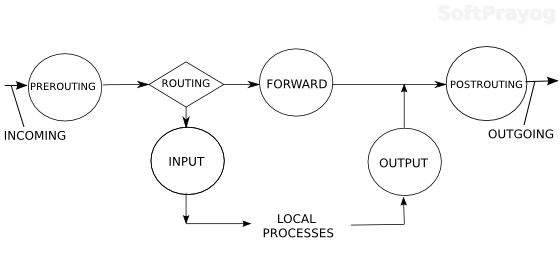
You can use a firewall to limit the number of concurrent connections and the rate of new connections coming from a network (e.g. a /32 for IPv4 and a /64 for IPv6). Example of what it may look like using iptables:
# Limit number of concurrent connections
-A INPUT -i eth0 -p tcp --syn -m connlimit --connlimit-above 50 -j DROP
# Limit rate of new connections
-A INPUT -i eth0 -p tcp --syn -m hashlimit --hashlimit-name tcp --hashlimit-mode srcip --hashlimit-above 3/sec --hashlimit-burst 7 --hashlimit-srcmask 32 -j DROP
(Same thing for ip6tables except adding --connlimit-mask 64 to the first and changing --hashlimit-srcmask to 64 in the second.)
I’ve searched quite extensively for this, but cannot seem to come up with a working example.
My objective is to monitor TCP traffic on a specific port to see incoming connections and write them to a text file. The catch is I also need a timestamp on each row to show exactly when the client connected down to the second.
I’ve already exhausted netstat, nmap, and tcptrack, but none support timestamp.
I was thinking a linux shell script might work if I monitored a specific local port and wrote text to a file when a connection is made then just concatenate the date on each line.
I was playing with this:
netstat -ano|grep 443|grep ESTABLISHED
as well as this:
tcptrack -i eth0 port 443
but neither suit my needs as I need the time the connection comes in at.
The netfilter framework, of which iptables is a part of, allows the system administrator to define rules for how to deal with network packets. Rules are grouped into chains—each chain is an ordered list of rules. Chains are grouped into tables—each table is associated with a different kind of packet processing.
Each rule contains a specification of which packets match it and a target that specifies what to do with the packet if it is matched by that rule. Every network packet arriving at or leaving from the computer traverses at least one chain, and each rule on that chain attempts to match the packet. If the rule matches the packet, the traversal stops, and the rule’s target dictates what to do with the packet. If a packet reaches the end of a predefined chain without being matched by any rule on the chain, the chain’s policy target dictates what to do with the packet. If a packet reaches the end of a user-defined chain without being matched by any rule on the chain or the user-defined chain is empty, traversal continues on the calling chain (implicit target RETURN). Only predefined chains have policies.
Rules in iptables are grouped into chains. A chain is a set of rules for IP packets, determining what to do with them. Each rule can possibly dump the packet out of the chain (short-circuit), and further chains are not considered. A chain may contain a link to another chain – if either the packet passes through that entire chain or matches a RETURN target rule it will continue in the first chain. There is no limit to how many nested chains there can be. There are three basic chains (INPUT, OUTPUT, and FORWARD), and the user can create as many as desired. A rule can merely be a pointer to a chain.
Tables
There are three built-in tables, each of which contains some predefined chains. It is possible for extension modules to create new tables. The administrator can create and delete user-defined chains within any table. Initially, all chains are empty and have a policy target that allows all packets to pass without being blocked or altered in any fashion.
filter table — This table is responsible for filtering (blocking or permitting a packet to proceed). Every packet passes through the filter table. It contains the following predefined chains, and any packet will pass through one of them:
INPUT chain — All packets destined for this system go through this chain (hence sometimes referred to as LOCAL_INPUT)
OUTPUT chain — All packets created by this system go through this chain (aka. LOCAL_OUTPUT)
FORWARD chain — All packets merely passing through the system (being routed) go through this chain.
nat table — This table is responsible for setting up the rules for rewriting packet addresses or ports. The first packet in any connection passes through this table: any verdicts here determine how all packets in that connection will be rewritten. It contains the following predefined chains:
PREROUTING chain — Incoming packets pass through this chain before the local routing table is consulted, primarily for DNAT (destination-NAT).
POSTROUTING chain — Outgoing packets pass through this chain after the routing decision has been made, primarily for SNAT (source-NAT).
OUTPUT chain — Allows limited DNAT on locally-generated packets
mangle table — This table is responsible for adjusting packet options, such as quality of service. All packets pass through this table. Because it is designed for advanced effects, it contains all the possible predefined chains:
PREROUTING chain — All packets entering the system in any way, before routing decides whether the packet is to be forwarded (FORWARD chain) or is destined locally (INPUT chain).
INPUT chain — All packets destined for this system go through this chain
FORWARD chain — All packets merely passing through the system go through this chain.
OUTPUT chain — All packets created by this system go through this chain
POSTROUTING chain — All packets leaving the system go through this chain.
In addition to the built-in chains, the user can create any number of user-defined chains within each table, which allows them to group rules logically.
Each chain contains a list of rules. When a packet is sent to a chain, it is compared against each rule in the chain in order. The rule specifies what properties the packet must have for the rule to match, such as the port number or IP address. If the rule does not match then processing continues with the next rule. If, however, the rule does match the packet, then the rule’s target instructions are followed (and further processing of the chain is usually aborted). Some packet properties can only be examined in certain chains (for example, the outgoing network interface is not valid in the INPUT chain). Some targets can only be used in certain chains, and/or certain tables (for example, the SNAT target can only be used in the POSTROUTING chain of the nat table).
La saturation du nombre d’ouverture de session TCP en cours.
2 – Le fonctionnement
2.1 – Schéma
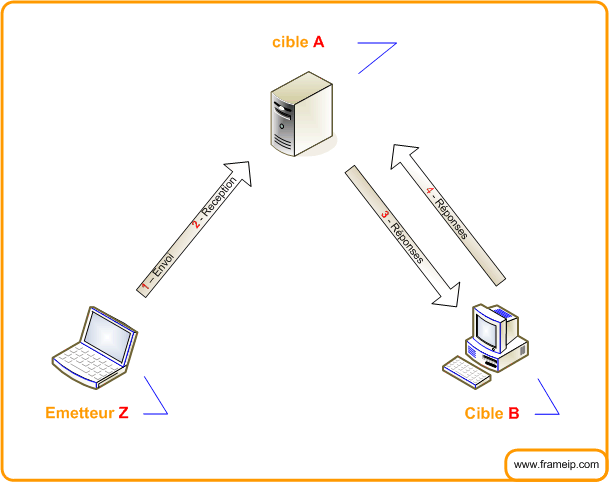
2.2 – Envoi du SYN
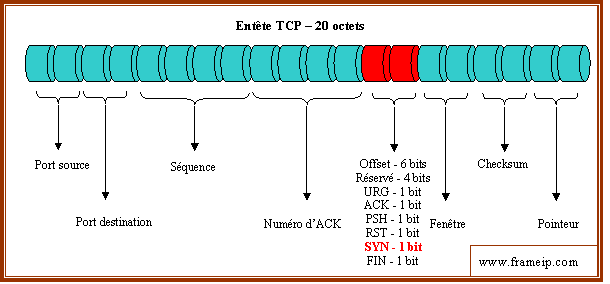
Le fonctionnement est de générer une trame TCP de demande de synchronisation à destination de la cible. Cette demande de synchronisation SYN est la première étape d’une ouverture de session TCP. Voici le schéma de l’entête TCP avec ce fameux flag SYN basé sur 1 bit :
Les 5 autres flags doivent être positionnés à 0.
2.3 – Réception par la cible A
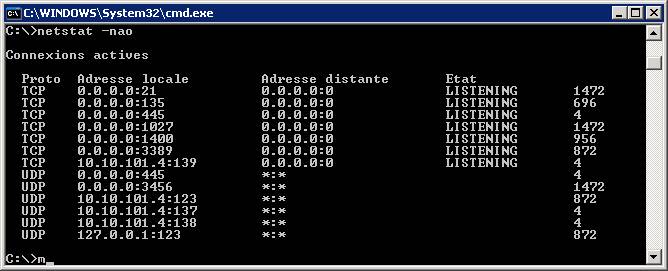
La cible recevant la synchronisation TCP mémorise cette demande nécessitant donc de la mémoire et du processeur. Voici l’état des connexions d’un Windows XP avant la réception d’un Synflood :
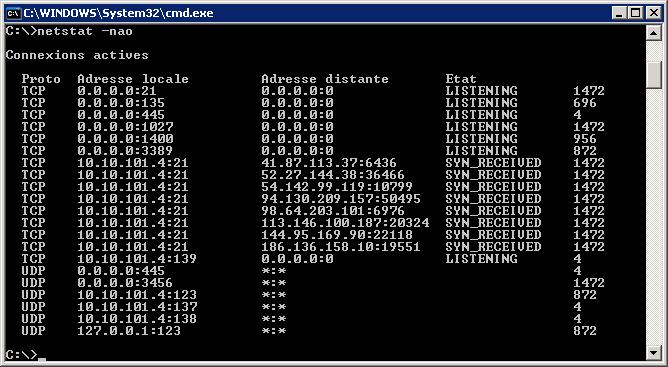
Et voici après la réception des demandes de SYN :
La cible passe les requêtes reçues en SYN_RECEIVED. Cet état est temporaire, le temps de durée de vie est variable en fonction de la pile IP.
Dans mon exemple, la cible tourne sur une station XP limitée en nombre de sessions simultanée. Ceci ayant pour conséquence l’indisponibilité temporaire du port ciblé.
* testé depuis la machine ayant effectuée le Synflood
To demonstrate how iptables can perform network address translation this how-to shows how to use it to implement a over-simplified load balancer. In practice we would use a daemon such as HAProxy allowing IP tables to check packets before forwarding them.
Using the method presented in this tutorial packets get forwarded without going through the INPUT, FORWARD and OUTPUT chains.
iptables is a powerful tool that is used to create rules for how incoming or outgoing packets are handled. It keeps track of a packets state – there is NEW, ESTABLISHED, RELATED, INVALID and UNTRACKED. It can make filtering decisions based on the packets header data and the payload section of the packet, for these purposes iptables even has regular expression matching.
On top of that iptables has extensions that can be used to filter packets based on a packets history so we can keep track of packets and sessions. We can set filters to only trigger at specific times, parse the packet contents and header information searching for specific patterns, differentiate protocols such as tcp, udp, icmp, etc.
For load balancing behavior we want the incoming packets on one machine to be routed to another machine. iptables has extentions that helps us achieve this aim but we also need to muck around with its internal PREROUTING and POSTROUTING table, which is not recommended as this could potentially pose a security risk. lets use iptables to route all traffic coming in on an interface eth0 with a destination port 80 and route it to another IP address:
Allow IP forwarding
(Note: if your testing this on the same box your doing this on it won’t work, you need at least 3 machines to test this out, virtual ones work nicely)
First we enable ipv4 forwarding or this will not work: # echo "1" > /proc/sys/net/ipv4/ip_forward
XOR
# sysctl net.ipv4.ip_forward=1
next we add a filter that changes the packets destination ip and allows us to masquerade:
The above filter gets added to iptables PREROUTING chain. The packets first go through the filters in the PREROUTING chain before iptables decides where they go. The above filter says all packets input into eth0 that use tcp protocol and have a destination port 80 will have their destination address changed to 1.2.3.4 port 80. The DNAT target in this case is responsible for changing the packets Destination IP address. Variations of this might include mapping to a different port on the same machine or perhaps to another interface all together, that is how one could implement a simple stateful vlan (in theory).
The masquerade option acts as a one to many NAT server allowing one machine to route traffic with one centralized point of access. This is similar to how many commercial firewalls and network routers function.
The above ruleset results in all incoming packets to dport 80 traversing the iptables chains in a straight line from INCOMING to OUTGOING in the image below, effectively bypassing any rules we might have had in our INPUT chain. If we were to choose to implement nat like this we would need to implement those – our desired INPUT filter rules – on the machines where traffic is forwarded OR add them to the FORWARD chain if we want to block things before they are forwarded (Note: packets might go through FORWARD chain in both directions so direction needs to be considered when writing filters for this chain).
Path incoming packets take through iptables chains