1. Installez sshfs:
sudo aptitude install sshfs
2. Créez le répertoire où apparaîtra le serveur ssh:
mkdir pointdemontage
3. Ajoutez les utilisateurs autorisés à utiliser le logiciel au groupe fuse :
sudo adduser username fuse
4. Montez le serveur ssh:
sshfs login@monserveurssh: pointdemontage
(N’oubliez pas les deux points (:) après le nom ou l’adresse du serveur ssh)
Et voilà !
Vous pouvez accéder au contenu de votre serveur ssh comme si c’était un simple répertoire local !
Pour démonter l’accès:
fusermount -u pointdemontage
Pour plus d’informations, voir la documentation ubuntu : http://doc.ubuntu-fr.org/sshfs
source: snippets.dzone.com
you need to extract the data in your http server log files and put it in a database to query it with your usual tools using SQL. this perl script does just this.
it was hard to find it, that’s why i put it here.
#!/usr/bin/perl -w
# Written by Aaron Jenson.
# Original source: http://www.visualprose.com/software.php
# Updated to work under Perl 5.6.1 by Edward Rudd
# Updated 24 march 2007 by Slim Amamou <[email protected]>
#  - output SQL with the option '--sql'
#  - added SQL create table script to the HELP
#
#  NOTE : you need the TimeDate library (http://search.cpan.org/dist/TimeDate/)
# Lire la suite...
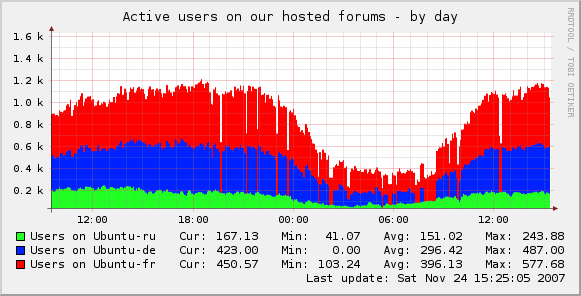 Here are some basic munin plugins for snort using perfmon (Enable preprocessor perfmonitor in
snort.conf)
The snort.conf entry should look something like:
preprocessor perfmonitor: time 300 file /your/path/to/snort.stats pktcnt 5000
(Read the snort docs for more info on performance issues etc.)
Drop Rate:
http://download.gamelinux.org/snort/snort_drop_rate
Pattern Matching:
http://download.gamelinux.org/snort/snort_pattern_match
Traffic speed:
http://download.gamelinux.org/snort/snort_traffic
Alerts:
http://download.gamelinux.org/snort/snort_alerts
Avg KBytes/pkt:
http://download.gamelinux.org/snort/snort_bytes_pkt
Avg Pkts/sec:
http://download.gamelinux.org/snort/snort_pkts
Edit any one of them, to graph what you want from perfmon output. It should be easy!
And now I will test them myself!
Update:
Here is a picture to give you an idea on how the graphs looks:
http://download.gamelinux.org/snort/Snort-Munin-Plugins.pngsource: http://www.gamelinux.org/?p=32
source: GAMELINUX
Source: nixCraft
What command I need to type to display Linux kernel version and other information such as Linux distribution name? How do I check Linux kernel version number?
You need to use the following two commands:
[a] uname - Print kernel and system information.
[b] lsb_release - Print distribution-specific information.
[c] /proc/version file - Print running kernel information.
How to check linux kernel version number?
Open a shell prompt (or a terminal) and type the following command to see your current Linux kernel version:
$ uname -r
Sample outputs:
2.6.32-23-generic-pae
Or type the following command:
$ uname -mrs
Sample outputs:
Linux 2.6.32-23-generic-pae i686
To print all information, enter:
$ uname -a
Sample outputs:
Linux vivek-laptop 2.6.32-23-generic-pae #37-Ubuntu SMP Fri Jun 11 09:26:55 UTC 2010 i686 GNU/Linux
Where,
- 2.6.32-23 – Linux kernel version number
- pae – pae kernel type indicate that I’m accssing more than 4GB ram using 32 bit kernel.
- SMP – Kernel that supports multi core and multiple cpus.
Lire la suite…
To change the order of the accounts in Thunderbird simply edit
~/.thunderbird/<your profile>/prefs.js in GNU/Linux,
C:\Documents and Settings\<your profile>\Application Data\Thunderbird\Profiles\****.default\prefs.js in Microsoft Windows XP,
Lire la suite…